Sintra review: a strong core, lost in its own surface
Twelve named AI employees from $15.60 a month, and the models underneath are perfectly capable. What defeats it is everything wrapped around them: ninety-plus Power-Ups, no guided path, an integration story that contradicts itself, and no WhatsApp at all.
Our rating: 2.6 out of 5 — the lowest we have given. Reviewed July 2026.
Disclosure: published by Altheo, which competes with Sintra on the marketing portion of what it does. This is the harshest review we have published, so every criticism is tied to Sintra’s own pages or a named third-party reviewer, and where our first impression turned out to be wrong we corrected it in Sintra’s favour. No affiliate links on this page.
The verdict
This is the lowest score we have given, and not because the product is bad. The core is fine: the helpers produce usable copy, posts and replies, Brain AI is a sensible idea, and at $15.60 a month on the annual plan it undercuts everything else in this category. There is a good product in here.
It is buried. Twelve helpers, each a character with an overlapping remit, multiplied by ninety-plus Power-Ups, on top of a context-store setup that needs half an hour before anything works well — and no guided path through any of it. Reviewers keep reporting the same experience, which is getting lost. Then there is the integration story, told three incompatible ways on Sintra’s own site, and WhatsApp, which is not supported at all.
A product sold to overwhelmed small business owners should reduce the number of decisions they face. This one multiplies them.
What Sintra actually is
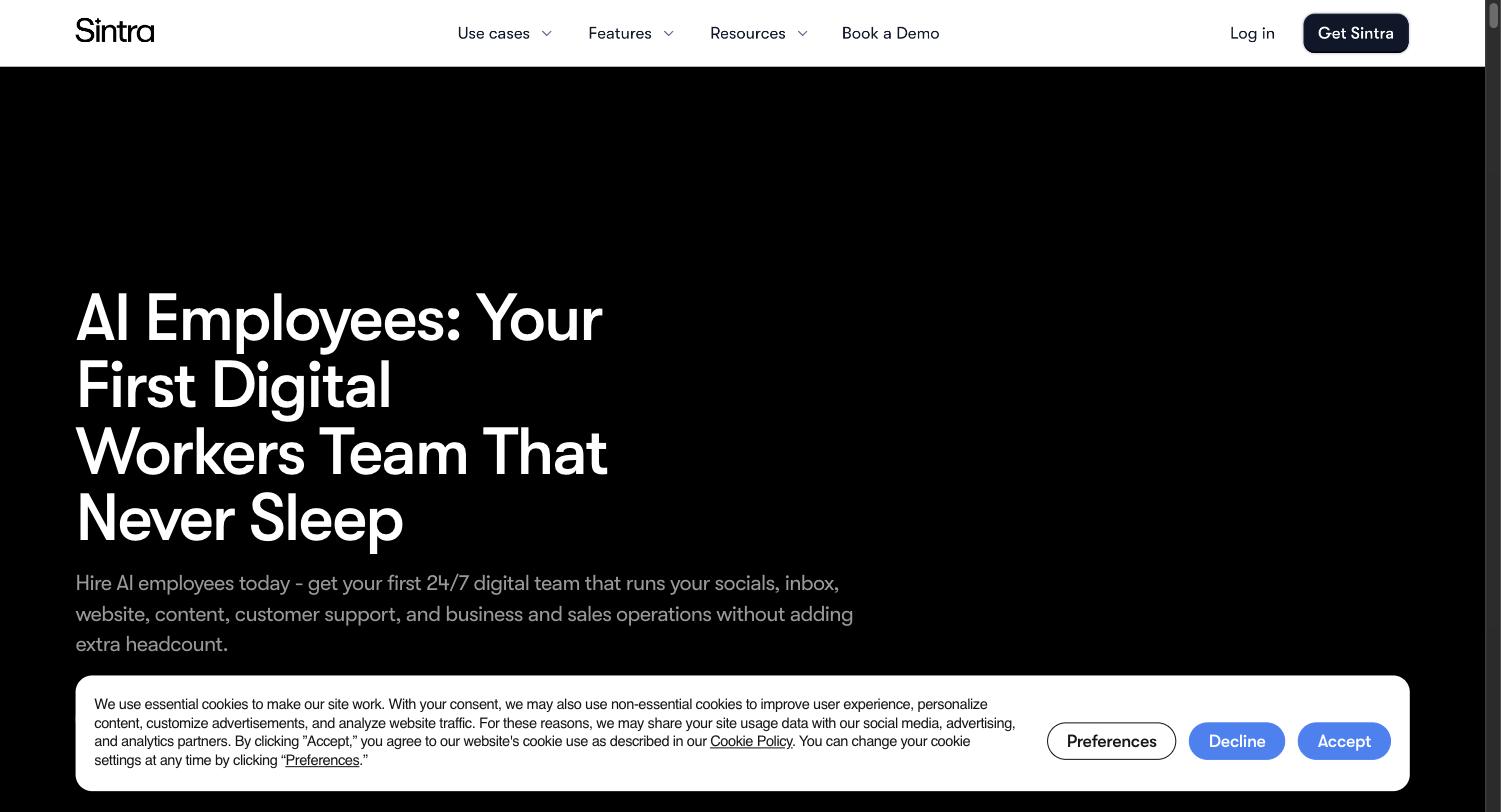
Sintra is operated by PlayOS, Inc. and sells what it calls AI employees: "Hire your first AI employees today — get your first 24/7 digital team." Twelve named characters each own a business function, and all twelve are included in every plan: Soshie for social media, Penn for copywriting, Seomi for SEO, Emmie for email, Cassie for customer support, Milli for sales, Commet for eCommerce, Dexter for data, Vizzy as a virtual assistant, Buddy for business development, Scouty for recruiting and Gigi for growth coaching.
Underneath sits Brain AI, a shared context store holding your brand tone, niche and audience, which every helper reads from. Around them sit 90+ Power-Ups — add-on workflows such as SEO audits, proposal drafting and content scheduling — plus a no-code builder and a marketplace where helpers you build can be published for others.
It is aimed squarely at non-technical small business owners. No coding is required anywhere, and that is worth stating clearly because the criticism that follows is not that Sintra is too technical. It is that it is too much.
It is not too technical. It is too much.
Sintra requires no coding. There is a no-code builder, one-click integrations, and the whole product is aimed at business owners with no technical background. On the axis of technical difficulty it scores well.
The difficulty is combinatorial. Twelve helpers, each with a persona and an overlapping remit. Ninety-plus Power-Ups distributed across them. A Brain AI context store that must be filled in properly before any of it performs. A marketplace on top. That is over a thousand plausible helper-and-Power-Up combinations, presented as a catalogue to browse rather than a path to follow.
The symptom shows up in review after review: without guided onboarding it is easy to get lost in the sheer number of features. That is not a complaint about capability, it is a complaint about the absence of a first, second and third step. Sintra is sold to overwhelmed operators as a way to stop drowning, and then hands them twelve employees to manage, ninety-plus tools to evaluate and a context store to configure.
None of this is unfixable, and it is a product problem rather than a technology one. A guided setup, a recommended starting helper, and five suggested Power-Ups for your business type would change the experience entirely without touching the models.
Integrations, and the WhatsApp problem
Sintra’s help centre answers the WhatsApp question directly: "No, you cannot integrate WhatsApp to Sintra or automate tasks via WhatsApp." Not difficult — unavailable. For a platform selling a customer support specialist and a sales manager, the absence of the world’s most-used business messaging channel is a structural gap rather than a missing nice-to-have, particularly across Latin America, Southern Europe, India and much of Asia and Africa.
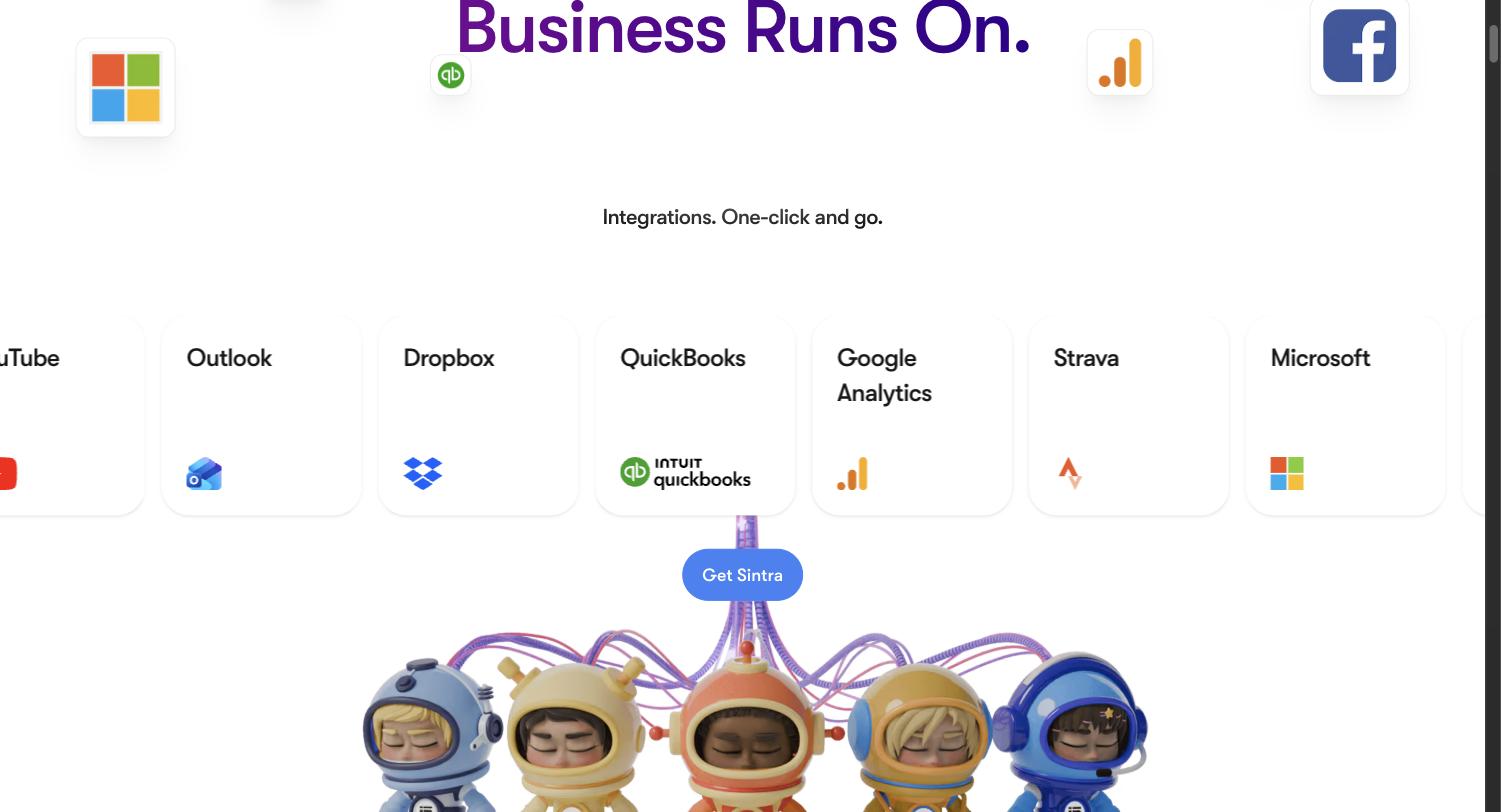
The wider integration picture is told three different ways on Sintra’s own website. The pricing page says "15+ integrations". The integrations page shows a modest grid — Meta Ads, YouTube, Outlook, Dropbox, QuickBooks, Google Analytics, Strava, Microsoft and similar. The help centre states Sintra "supports over 1,000 integrations through Composio". Those answers differ by two orders of magnitude and no page reconciles them, so a buyer cannot plan around any of them. Verify the specific integrations you need during the trial.
Pricing: cheap, and stranger than it looks
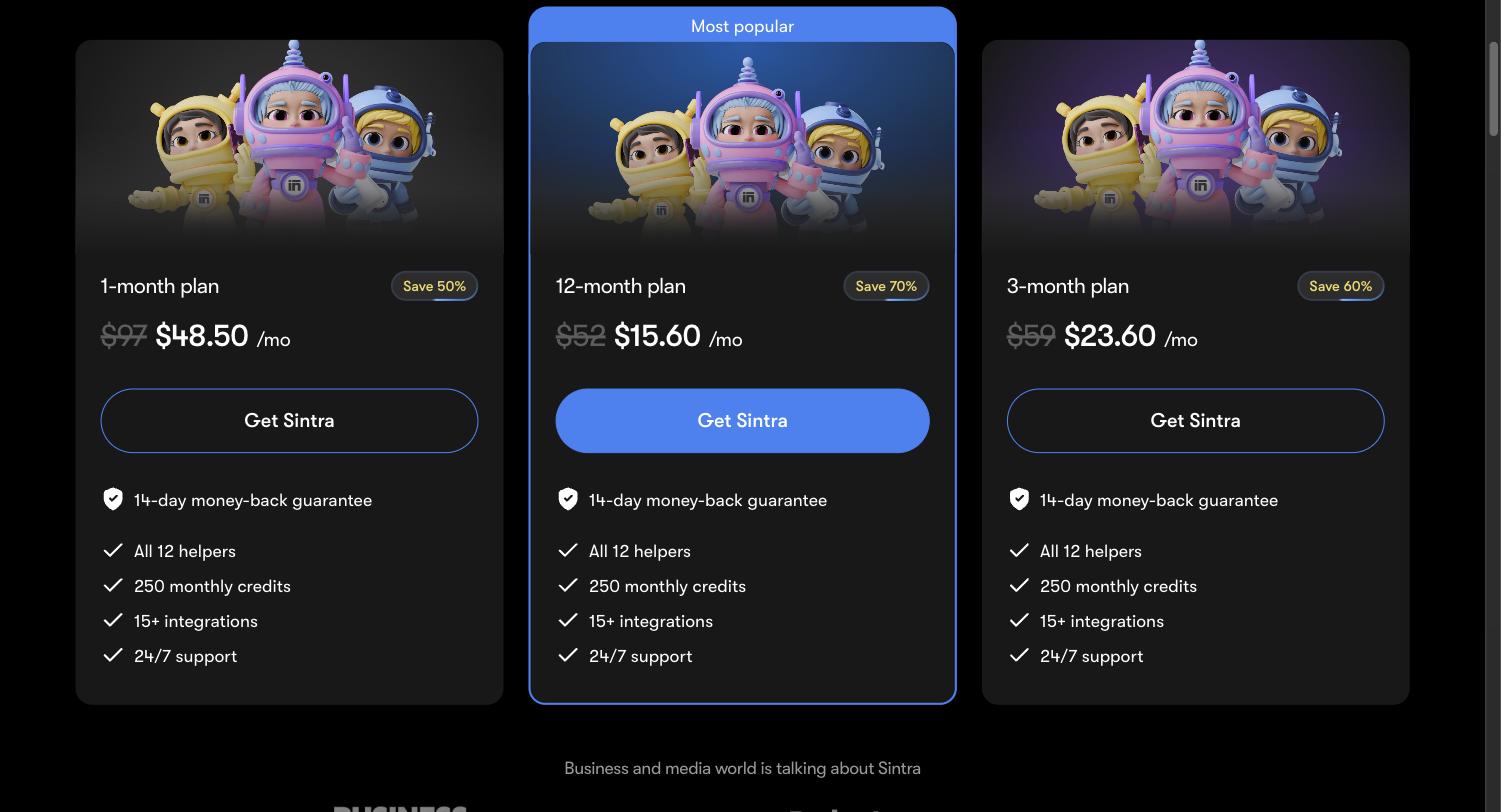
$48.50 a month for one month, $23.60 for three, $15.60 for twelve. Every plan includes all twelve helpers, 250 monthly credits, "15+ integrations" and 24/7 support, and differs only by commitment length. There is a 14-day money-back guarantee, which matters given how much of this product can only be assessed by using it.
Two structural quirks are worth knowing. Credits do not scale with price: all three plans give 250 a month, so paying $48.50 instead of $15.60 buys a shorter commitment rather than more capacity, and reviewers report active users exhausting 250 credits in two to three days.
And individual helpers cost $39 a month each — 80% of the price of all twelve on the monthly plan. As a standalone product that is very hard to recommend to anybody; as a reference price that makes the bundle look generous, it does its job. To be clear about a common misconception: you do not have to buy the helpers separately. Every plan includes all twelve. The fragmentation people feel is real, but it lives in the Power-Ups rather than the helpers.
Who it suits, and how it compares to Altheo
Sintra may suit you if you are technical, enjoy configuring systems and might publish helpers to the marketplace; if you want the cheapest possible entry into AI assistance and will invest time learning it; if your workflow is genuinely multi-departmental rather than just marketing; and if you will complete the Brain AI setup properly before judging the output.
Avoid it if your customers reach you on WhatsApp, since there is no workaround; if you want a tool that tells you what to do next rather than presenting a catalogue; if you are time-poor, because the setup cost is the real price here; or if you need dependable, specific integrations, because Sintra cannot tell you consistently what it has.
Altheo competes on the marketing portion, so weigh this accordingly. Sintra is more ambitious — twelve roles across support, sales, recruiting, e-commerce and admin, far wider than marketing and far wider than us. That breadth is exactly what produces the navigation problem: the wider a product reaches, the more a user needs a map through it. Altheo covers five pillars organised by the outcome each drives rather than by job title, so there is one obvious next thing to do. On price, Sintra wins outright — $15.60 a month is less than anything we or our competitors charge.
Frequently asked questions
How much does Sintra cost?
All three plans include the same thing — all 12 helpers, 250 monthly credits, 15+ integrations and 24/7 support — and differ only by commitment. One month is $48.50 (from a struck-through $97), three months is $23.60 (from $59), and twelve months is $15.60 (from $52). Individual helpers are also sold at $39 a month each. That last number is worth a moment: one helper at $39 costs 80% of what all twelve cost on the monthly plan, which makes the single-helper option difficult to recommend to anyone and suggests it exists mainly to make the bundle look generous. There is a 14-day money-back guarantee.
Do you have to buy the AI agents separately?
No — and this is worth correcting, because it is a common impression. Every Sintra plan includes all twelve helpers. Individual helpers can be bought separately at $39 a month, but that is a worse deal than the full bundle in almost every case. What is genuinely tiered is the Power-Ups: the 90+ add-on workflows that turn helpers from chat assistants into automation, with access varying by plan. So the fragmentation people feel is real, it just sits in the Power-Ups rather than the helpers.
Does Sintra work with WhatsApp?
No. Sintra’s own help centre answers this directly: "No, you cannot integrate WhatsApp to Sintra or automate tasks via WhatsApp." Not difficult, not on the roadmap as far as anything published says — simply unavailable. For a product sold as a customer support and sales team, in a world where WhatsApp is the default business channel across Latin America, Southern Europe, India and much of Africa and Southeast Asia, that is a significant hole rather than a missing nice-to-have.
How many integrations does Sintra actually have?
This depends which Sintra page you read, which is itself the problem. The pricing page says "15+ integrations". The integrations page shows a modest set — Meta Ads, YouTube, Outlook, Dropbox, QuickBooks, Google Analytics, Strava, Microsoft and similar. The help centre, meanwhile, states Sintra "supports over 1,000 integrations through Composio". Those are three materially different answers on the same website. If integrations decide your purchase, verify the specific ones you need during the trial rather than trusting any of these figures.
Is Sintra too complicated?
For its stated audience, often yes — though not for the reason people assume. Sintra is explicitly built for non-technical small business owners: there is a no-code helper builder and no coding is required anywhere. The difficulty is not technical depth, it is sprawl. Twelve helpers, each with its own personality and remit, 90+ Power-Ups, a Brain AI context setup that reviewers say deserves at least 30 minutes before anything works well, and a marketplace on top. Reviewers repeatedly note that without guided onboarding it is easy to get lost in the sheer number of features. A product aimed at overwhelmed operators should not itself be overwhelming.
What are Sintra credits and do they run out?
Every plan includes 250 credits a month regardless of price, and credits are consumed by helper actions. Reviewers report heavy users exhausting them in two to three days. That is the same metering pattern we criticised in Okara, with one difference: because all three Sintra plans carry the same 250 credits, paying more does not buy more capacity — it only buys a longer commitment at a lower monthly rate. If you plan to use this daily, budget for top-ups from the start.
Is Sintra worth it for developers?
It is the one audience for whom the sprawl might be a feature rather than a bug. Sintra offers an API, and its marketplace lets you build helpers with the no-code builder and publish them for others to use. If you enjoy assembling systems and want to package your own expertise as a sellable helper, there is something here. But note the irony: a platform marketed at non-technical business owners is arguably most rewarding for the technical users it was not designed for.
How does Sintra compare to Altheo?
We compete, so weigh this accordingly. Sintra is broader in ambition — twelve roles spanning support, sales, recruiting, e-commerce and admin, where we only do marketing. That breadth is exactly what produces the navigation problem: the more territory a product covers, the more a user needs a map through it. Altheo covers five pillars — technical, on-page SEO, off-page SEO, website conversion and social — organised by the outcome each drives rather than by fictional job titles, and our conversion review is read by a person. If you want an AI workforce across your whole business and enjoy configuring things, Sintra is the more ambitious purchase. If you want marketing to work and would rather not spend a weekend learning a tool, we would point you elsewhere.
How was this review put together?
From Sintra’s own public pages — homepage, pricing, integrations and help centre — read in July 2026, plus hands-on reviews published by Cybernews, Lindy, Gmelius, eesel and others. All screenshots are our own captures. We did not run a paid account through a full month, so this assesses the product’s claims, structure and documented user experience rather than reporting our own results. Where reviewers describe an older plan structure — a $47 Pro tier and a $97 Sintra X tier — we have used the pricing currently published on Sintra’s own site instead, and noted that the structure appears to have changed.