Search Atlas review: a strong platform with one wrong default
Search Atlas is the most substantial product we have reviewed — an agency-built platform at roughly $30M ARR serving 30,000+ customers, where one $99 subscription covers work that normally needs three tools. Its automation engine, OTTO, does something rivals only describe: it ships fixes to a live site. The question this review turns on is who can see them.
Our rating: 4.2 out of 5 — the highest we have given. Reviewed August 2026.
Disclosure: published by Altheo, which competes with Search Atlas on the technical and on-page pillars. The central criticism below is quoted from Search Atlas's own help centre rather than inferred, and we credit them for documenting it plainly when they could have stayed quiet. There are no affiliate links on this page — which distinguishes it from much of what ranks for this query.
The verdict
Search Atlas earns its reputation. It is broader than anything else in this review set — keyword research, technical auditing, content, link building, local SEO, paid ads and AI visibility tracking inside one subscription starting at $99 — and it is the only product here that closes the loop between finding a problem and fixing it. OTTO applies titles, meta descriptions, schema and internal links to the live page, with an approval step, which removes the bottleneck that kills most SEO programmes: knowing the fix and having nobody to ship it.
The reservation is architectural rather than a matter of quality. OTTO's default deployment is a JavaScript pixel, and Search Atlas's help centre states the consequence: "AI crawlers and non-JS bots only see edge-rendered content, not JS-injected fixes." GPTBot, ClaudeBot and PerplexityBot do not run JavaScript, so on a default install every optimisation OTTO makes is invisible to them — on a platform that sells LLM visibility tracking as a paid feature. There is a fix, the Cloudflare edge integration, and it works. It is simply not the default, and nothing in the product tells you which mode you are in.
What Search Atlas actually is
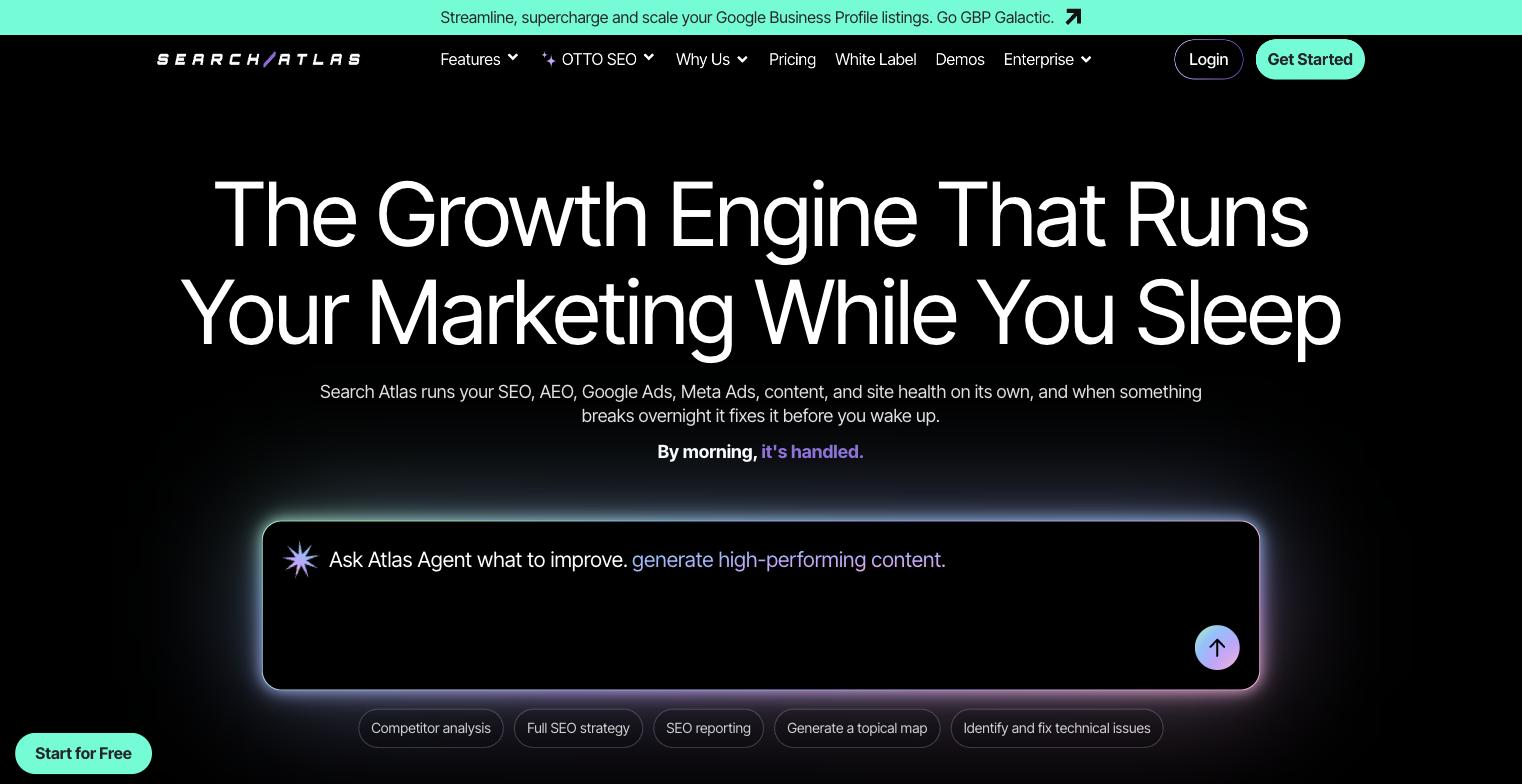
An AI SEO automation platform, headlined "The Growth Engine That Runs Your Marketing While You Sleep". It grew out of LinkGraph, an SEO agency founded in 2019 by Manick Bhan and Sophia Deluz-Bhan, and the agency origin shows in the product: the tooling was built to make a services team faster, then sold.
One word in the homepage subhead is worth holding onto for the section below. Search Atlas says it runs "your SEO, AEO, Google Ads, Meta Ads, content, and site health on its own" — AEO being answer engine optimisation, the discipline of being cited by AI assistants. It is sold on the homepage, before you reach any pricing page.
Six components sit under one subscription. OTTO SEO applies technical and on-page fixes from live search data. Atlas Agent handles competitor analysis, topical mapping and reporting. Smart Ads manages Google and Meta campaigns. GBP Galactic maintains Google Business Profiles across locations. Website Studio generates and publishes pages. LLM Visibility tracks whether you appear in AI-generated answers.
The scale is real and worth stating, because most products in this category have none: roughly $30M ARR reached profitably without significant venture funding, 30,000+ customers and 5,000+ agencies. Search Atlas is not a thin wrapper with a landing page.
The pixel problem, in Search Atlas's own words
OTTO does not write into your CMS. Search Atlas is explicit: "OTTO changes are client-side rendered and won't appear in your CMS." The optimisations exist in the browser's DOM at render time, not in your database or your files. That is a deliberate design — it sidesteps caching plugins, page builders and CMS access entirely, and it makes rollback instant.
It also decides who can read them. The help centre documents two deployment modes: "Client-side via the OTTO Pixel — JavaScript injection seen by users and JS-rendering bots like Googlebot" and "Edge-level via the Cloudflare DNS integration — raw HTML modification seen by all crawlers." Then the consequence, stated without hedging: "AI crawlers and non-JS bots only see edge-rendered content, not JS-injected fixes."
This is not a Google problem. Googlebot executes JavaScript and sees OTTO's work, so the traditional SEO case is unaffected. It is specifically an AI-visibility problem, and it lands on the exact platform that advertises AEO on its homepage and sells LLM visibility tracking on its Growth and Pro tiers. A customer can pay for a dashboard reporting that they are absent from AI answers while the tool's own optimisations are the thing those assistants cannot see.
We tested this rather than assuming it. searchatlas.com runs the OTTO pixel itself, so we fetched the homepage twice — once as GPTBot with no JavaScript, once in a browser that executes it. The title differs ("AI SEO Automation Platform & Growth Engine | Search Atlas" raw, against "Search Atlas: AI SEO Automation for Agencies & Brands" after JavaScript), the meta description differs, and the rendered page carries five JSON-LD blocks against three in the raw HTML. The raw HTML is byte-identical whether requested as GPTBot or as Chrome, which rules out different content being served to different agents: it is the same document, rewritten in the browser after it arrives.
What that shows precisely: Search Atlas's homepage is not invisible to AI crawlers — 1,330 words and three schema blocks reach GPTBot perfectly well, because the underlying site is server-rendered. What GPTBot does not get is the optimised version. It reads the pre-OTTO title, the pre-OTTO description and two fewer pieces of structured data. The page is legible; the SEO work on it is not. On a site whose raw HTML is already good, OTTO therefore costs nothing with AI crawlers and adds nothing either. On a site whose raw HTML is thin — an SPA, a JavaScript-heavy builder — OTTO is doing the work that would have fixed exactly that, in the one place those crawlers cannot read.
Two practical consequences follow, and both are worth weighing before buying. If AI citation matters to you, the Cloudflare integration is not optional — it is the only mode that works, and it requires moving DNS. And whichever mode you choose, the improvements are rented rather than owned: remove the pixel and every change reverts, leaving nothing behind in the site itself. For an agency handing a site back to a client, that is a material detail.
Pricing, and the tier that matters
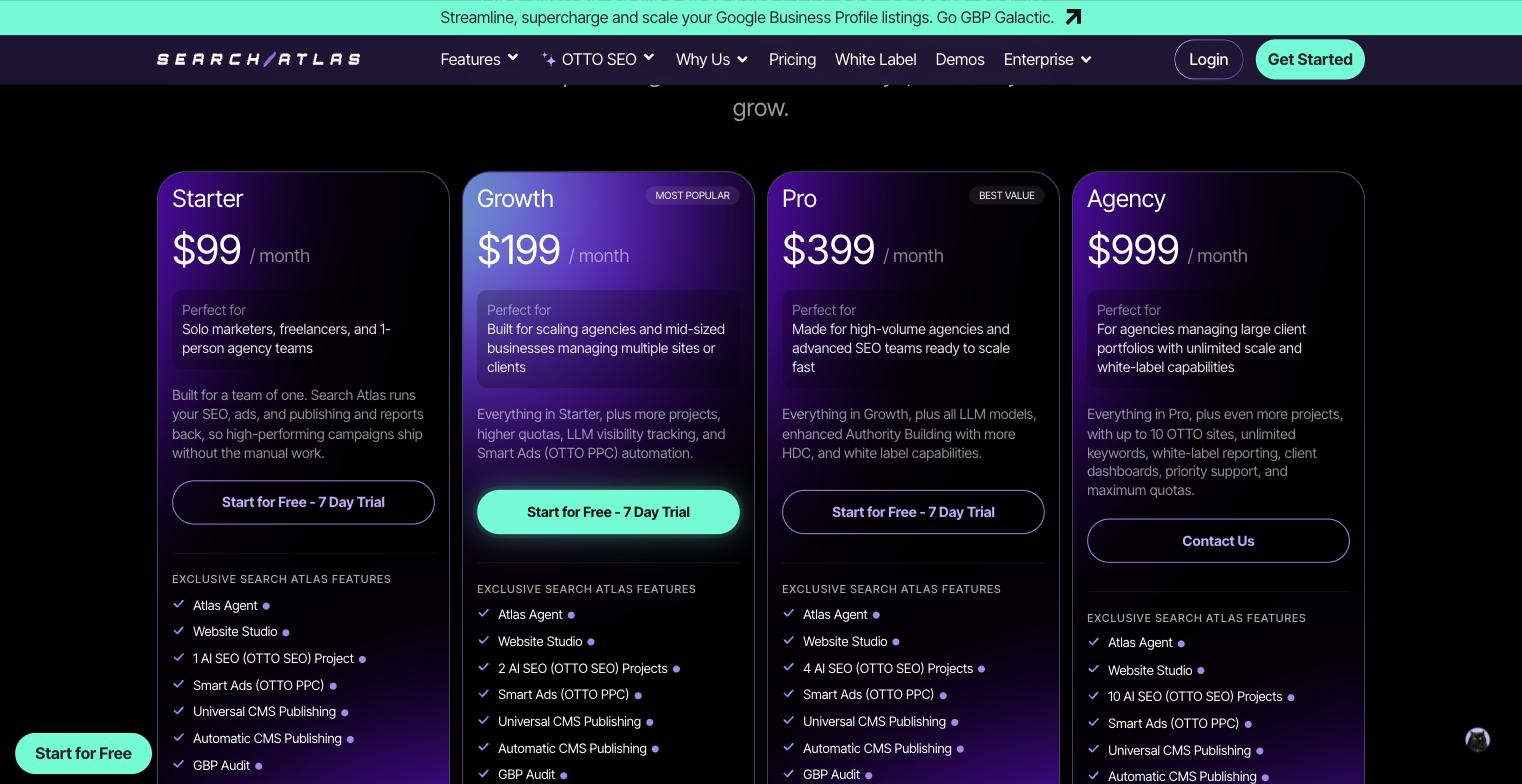
Four public tiers: Starter $99, Growth $199, Pro $399 and Agency $999 a month, each with a 7-day trial. Pricing is published, which is more than several competitors manage, and the tiers gate by quantity rather than capability — projects, seats, content pages, article credits and universal credits all scale with price.
One boundary is not about quantity. LLM visibility tracking is absent from Starter entirely, covers 3 AI platforms on Growth, and reaches 5 including Perplexity and Copilot on Pro. If you are buying Search Atlas because of AI search, the $99 tier does not do the thing you are buying it for, and the tier that does is $199.
Against the field, $99 is competitive — meaningfully below Semrush's entry tier for a wider feature set. The honest comparison is not on price though: Semrush and Ahrefs have deeper and more trusted index and backlink data built over many more years. Search Atlas wins on breadth and on shipping fixes, not on data quality.
The closest comparison among the tools we have reviewed is Outrank, also $99 a month, which we rated 4.1. The two automate opposite halves of the same job: Outrank writes and publishes new SEO articles into your CMS, where they stay; OTTO improves the pages you already have, and on the pixel deployment the improvements live only in the rendered page. If your gap is that you have no content, Outrank is the closer fit. If your gap is that the content you have is not optimised, Search Atlas is.
What independent reviewers report
The rating spread is the most informative thing about Search Atlas's reception. Capterra sits at 4.7 from 85 reviews and G2 around 4.5 from roughly 129 — both strong. Trustpilot sits at 3.8 from around 327 reviews. Platforms that people visit deliberately to evaluate software rate it well; the platform people reach when they have a billing problem rates it lower, and has four times the volume.
Two complaint themes recur. Billing: charges during a free trial, charges continuing after a confirmed cancellation, and at least one documented case of a refund promised in writing three times and never paid. Reliability during onboarding: bugs, unstable WordPress integrations, slow dashboards, and automation that occasionally broke site behaviour. A steep learning curve appears in positive reviews too, usually paired with praise for the onboarding calls that offset it.
A note on the wider review landscape, since it affects what you will find searching for this product. A large share of the "best SEO tools 2026" articles ranking for these queries carry affiliate links, and Search Atlas's own blog ranks at or near the top of that query with an article placing itself first. That is effective SEO and entirely legal; it also means the visible consensus about this product is substantially purchased or self-authored. Weigh the independent platforms accordingly — and weigh us accordingly too, since we compete with them.
Who it is for, and how it compares to Altheo
Buy Search Atlas if you have more diagnosed SEO problems than engineering time to fix them, because shipping fixes without a developer is the genuine differentiator. It suits agencies especially well — white-labelling, multi-location GBP automation and per-project structure are all built for that shape of work. If you would otherwise pay for Semrush plus a content tool plus a local SEO tool, one $199 subscription is a real consolidation.
Look elsewhere if your priority is being cited by AI assistants and you cannot move DNS to Cloudflare; if you need SEO improvements to persist as real artefacts in your CMS rather than a rendered overlay; if backlink and index data quality is the thing you are actually buying, where Ahrefs and Semrush remain stronger; or if you are on Starter and expecting AI visibility tracking, which is not included there.
Altheo competes with Search Atlas on two of five pillars, so weigh this accordingly. Search Atlas is broader and more mature than we are — paid ads, GBP automation at scale, link building and agency white-labelling are things we do not do, and we have nothing that pushes a fix live the way OTTO does. Where we differ is that Altheo is organised by outcome rather than by tool, several tools are free with no account, and our AI Readiness check exists to answer precisely the question this review raises: what an AI crawler receives when it fetches your page, measured against what a visitor sees. Anyone running OTTO on the pixel should look at that gap before trusting an AI visibility dashboard.
Frequently asked questions
How much does Search Atlas cost?
Search Atlas has four public tiers: Starter at $99 a month, Growth at $199, Pro at $399 and Agency at $999, each with a 7-day free trial. The tiers gate almost everything by quantity rather than capability — Starter gives you 1 OTTO SEO project, 1 user seat, 40 content pages, 30 AI article credits and 50,000 universal credits a month; Growth doubles the projects to 2 and adds 3 seats and 120,000 credits; Pro reaches 4 projects, 5 seats and 400,000 credits. One tier boundary matters more than the numbers: LLM visibility tracking does not exist on Starter at all, arrives on Growth covering 3 AI platforms, and reaches 5 platforms including Perplexity and Copilot on Pro.
What is OTTO SEO and does it actually change your website?
OTTO is Search Atlas's automation engine, and yes — it changes the page a visitor loads, which is genuinely unusual. Most SEO tools produce a list of fixes and leave the implementing to you; OTTO applies titles, meta descriptions, schema markup, internal links and content blocks itself, with an approval mode so nothing goes live unreviewed. What it does not do is write into your CMS. Search Atlas states this directly: "OTTO changes are client-side rendered and won't appear in your CMS." The changes live in the browser's DOM at render time, not in your database or your files, which is why they can be rolled back instantly — and why they disappear the moment you remove the pixel.
Can ChatGPT and other AI crawlers see OTTO's changes?
Only if you deploy OTTO through Cloudflare rather than the pixel. Search Atlas's help centre describes two modes: "Client-side via the OTTO Pixel — JavaScript injection seen by users and JS-rendering bots like Googlebot" and "Edge-level via the Cloudflare DNS integration — raw HTML modification seen by all crawlers." It then states the consequence outright: "AI crawlers and non-JS bots only see edge-rendered content, not JS-injected fixes." GPTBot, ClaudeBot and PerplexityBot do not execute JavaScript, so on the default pixel install every optimisation OTTO makes is invisible to them. Googlebot renders JavaScript and does see them, so this is not a Google problem — it is specifically an AI-visibility problem, on a platform that also sells AI visibility tracking.
Is Search Atlas legitimate, or is the hype affiliate-driven?
The company is real and substantial — that part is not hype. Search Atlas grew out of LinkGraph, an SEO agency founded in 2019 by Manick Bhan and Sophia Deluz-Bhan, and has been scaled to around $30M ARR profitably without significant venture funding, serving 30,000+ customers and 5,000+ agencies. The review landscape around it is a different matter. A large share of the "best SEO tool 2026" articles ranking for Search Atlas queries carry affiliate links, and Search Atlas's own blog ranks at or near the top for those terms with an article placing itself first. Weigh independent review platforms over blog rankings here, and note that we are a competitor, so weigh us accordingly too.
What do real users complain about?
Two themes recur across independent platforms. The first is billing: reports of charges during a free trial, charges continuing after a confirmed cancellation, and in at least one G2 account a refund promised in writing three times and never paid. The second is reliability during onboarding — software bugs, unstable WordPress integrations, slow dashboards, and automation that occasionally broke site behaviour. The rating spread tells the same story: Capterra sits at 4.7 from 85 reviews and G2 around 4.5 from roughly 129, while Trustpilot — where people tend to arrive with a billing problem — sits at 3.8 from around 327. A product can be genuinely good and still have a support function under strain, and that is the most likely reading here.
Is Search Atlas better than Semrush or Ahrefs?
It is not better at the thing those two are best at, and it does something neither of them does. Semrush and Ahrefs have deeper, more trusted index and backlink data built over many years, and if the quality of the underlying data is what you are buying, they remain the stronger choice. Search Atlas is competitive on price — its $99 entry is meaningfully below Semrush's — and it is the only one of the three that will implement a fix on your live site rather than describe it. Whether that trade favours you depends on your bottleneck: if you know what to fix and nobody has time to ship it, Search Atlas wins; if you need the most reliable data to decide what to fix, it does not.
Who should not buy Search Atlas?
Anyone whose main goal is being cited by AI assistants and who cannot move their DNS to Cloudflare, because the default deployment mode is invisible to those crawlers by design. Anyone who needs their SEO improvements to be permanent assets rather than a rendered overlay — agencies handing sites back to clients, or anyone who might churn, should understand that removing the pixel reverts everything. Anyone buying primarily for backlink data or index depth, where Ahrefs and Semrush are stronger. And anyone on the Starter tier expecting AI visibility tracking, which is not included at that price.
How does Search Atlas compare to Altheo?
They overlap on the technical and on-page pillars and diverge everywhere else. Search Atlas is broader and far more mature: paid ads, Google Business Profile automation at scale, link building and an agency-grade white-label layer are all things Altheo does not do, and OTTO's ability to push a fix live has no equivalent in our product. Altheo is narrower and organised by outcome across five pillars, several tools are free with no account, and our AI Readiness check exists specifically to answer the question this review raises — whether the version of a page an AI crawler receives contains anything worth quoting. If you run OTTO on the pixel, that check will show you exactly what GPTBot sees, which is not what you see.