Outrank review: SEO content on auto-pilot, honestly assessed
Thirty published articles a month for $99, written, illustrated and pushed straight into your CMS — plus backlinks from a network of other customers. The on-page half is excellent. The off-page half needs a decision rather than a default.
Our rating: 4.1 out of 5. Reviewed July 2026.
Disclosure: this review is published by Altheo, and Outrank overlaps with our own on-page and off-page work more than any other product we have reviewed. We also take a different view on reciprocal link building, which we do not do. There are no affiliate links on this page.
The verdict
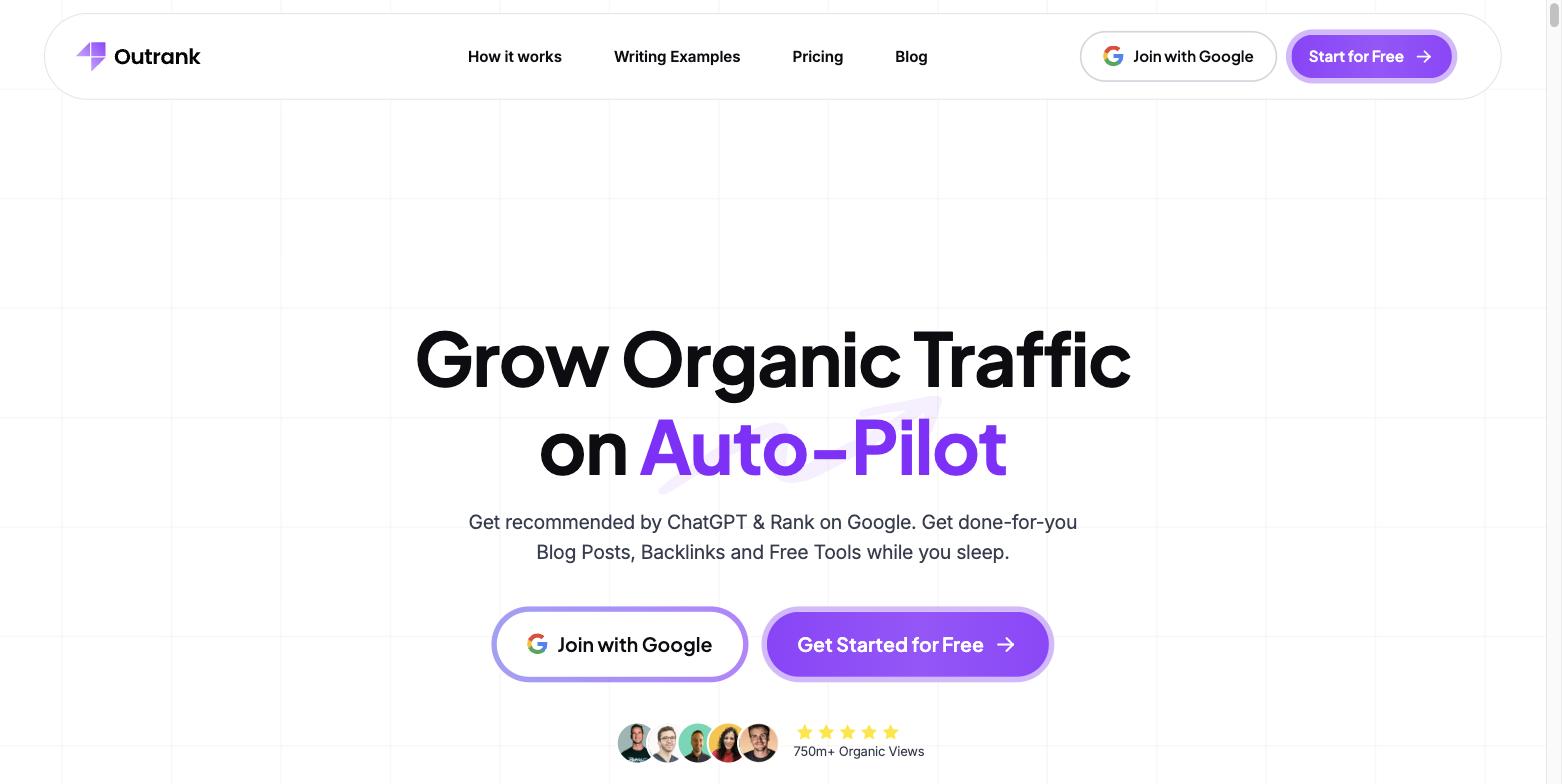
Outrank does the thing almost everyone intends to do and almost nobody sustains: publish consistently. It researches the keyword, writes the article, makes the images, adds the links, and pushes it live in your CMS without you touching it. At $99 for thirty articles a month that is roughly $3.30 each, against $100 or more for a freelancer who would still hand you a document to upload yourself.
Two things temper it. You will be editing — independent reviewers put content quality near 3 out of 5, and a fifth to a third of articles want a pass before they go live. And the backlinks come from a reciprocal exchange between customers, which works, moves Domain Rating quickly, and sits in exactly the territory Google’s link spam guidance describes. Neither is a reason to avoid it. Both are reasons to use it deliberately.
What Outrank actually is
Outrank launched in early 2025, built by Tibo (Thibault Louis-Lucas) and Eugene Zolotarenko, and operates as Outrank SARL out of Paris. Tibo previously built Tweet Hunter and Taplio and sold them together for a reported $8M; he also builds SuperX, which we reviewed separately. Outrank passed $1M ARR in 2025 — his fourth product to do so.
You connect your site and your CMS, and it takes over: keyword research, article generation at 1,200–1,700 words with headings, meta descriptions and internal links, AI images, embedded video where relevant, and publication — no draft sitting in a dashboard waiting for you. Alongside that runs the Backlink Exchange, which places links between customer sites automatically.
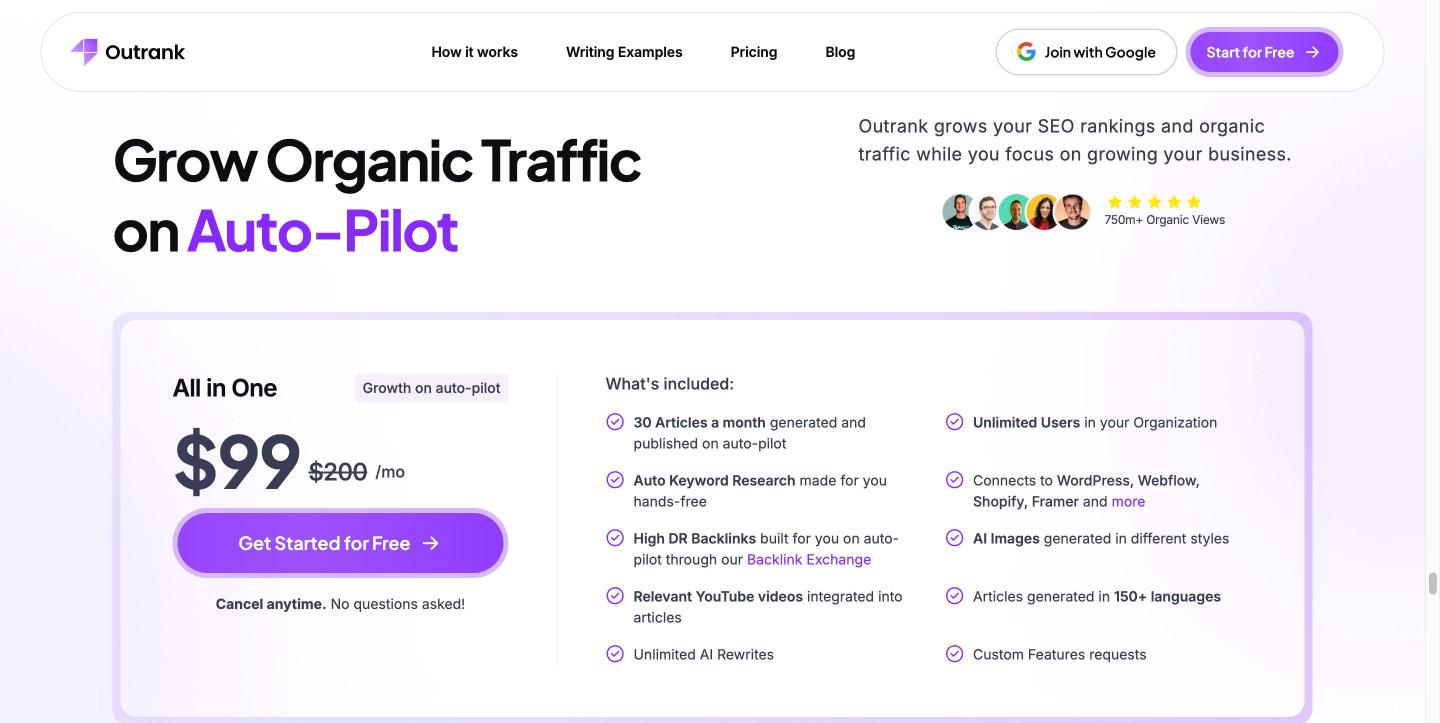
One plan, $99 a month, thirty articles, unlimited users, with volume discounts for multiple sites and optional upgrades to 60 or 90 articles. Integrations cover WordPress, WordPress.com, Webflow, Shopify, Framer, Wix, Notion, Ghost, Next.js and a generic webhook.
The Backlink Exchange, mechanism first
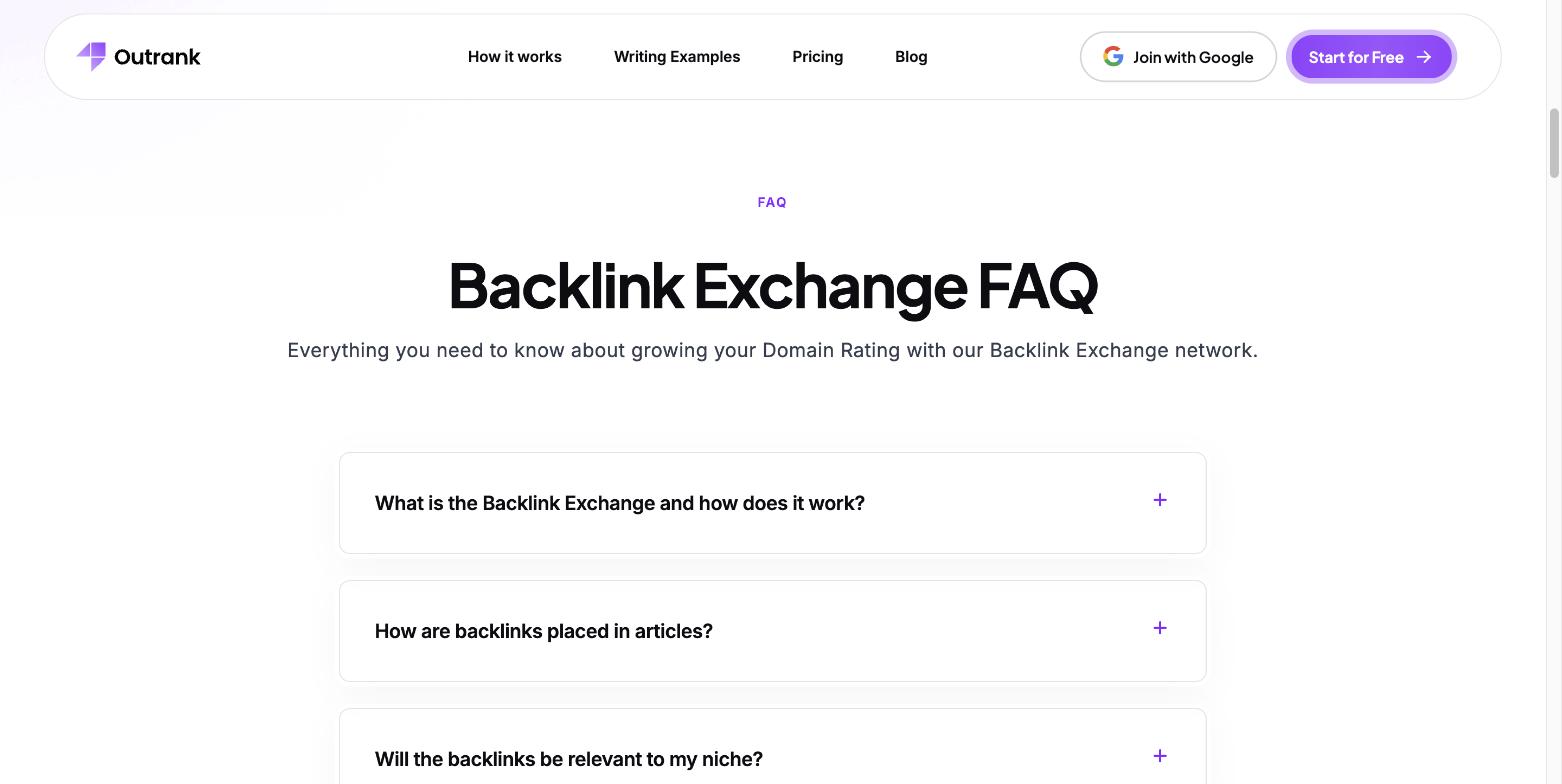
It is not a simple you-link-to-me-and-I-link-to-you swap. It runs on a credit economy. In Outrank’s words: "You earn credits by hosting backlinks from other users in your articles. You spend credits to get backlinks placed in other users’ articles." Sites with a higher Domain Rating earn more credits per link hosted, and credits reset daily.
That design matters twice over. The link graph is not neatly reciprocal — A hosts a link for B while C links to A — so the footprint spreads across a network rather than leaving obvious pairs. And a higher-authority site is paid more for its outbound links, which is a marketplace with a price, denominated in credits rather than dollars.
Placement is inside the article body: "Links are inserted within the article text, not in footers or sidebars." Matching is topical: "Your website is matched with articles that are topically relevant to your industry and content." Outrank says most users see measurable Domain Rating movement within two to four weeks.
It would be lazy to file this next to link farms. Three design decisions separate it from one: links sit in the body of real published articles rather than footers or doorway pages, they are matched by topic, and the hosting pages are genuine content on real customer sites rather than a private blog network built as a link substrate. Those are exactly the attributes that distinguish a link Google is likely to count from one it discounts, and Outrank documents the mechanism publicly, which most link vendors do not.
Where the exchange meets Google’s written policy
Google’s spam policies name three things that bear directly on this. Excessive link exchanges: "Excessive link exchanges ('Link to me and I'll link to you') or partner pages exclusively for the sake of cross-linking". Automated link building: "Using automated programs or services to create links to your site". And under paid links, "Exchanging goods or services for links" — money is not required for that clause to apply.
The second is hard to argue with. Whatever the topology, this is an automated service creating links to your site; that is the product. And the credit economy means links are obtained in exchange for a service you render, which is the language of the third clause even though no money changes hands.
The decisive question is one Outrank does not answer: are the links dofollow? Nothing on the Backlink Exchange page says, and it is the whole question — Google states that qualifying links with rel="nofollow" or rel="sponsored" takes an arrangement out of scope because no ranking credit passes. The answer can be inferred from the marketing. The entire pitch is Domain Rating growth, and Ahrefs computes Domain Rating from followed links; if these were nofollowed, DR would not move, and DR moving is exactly what customers report. So the links are almost certainly followed, which places the arrangement inside the policy rather than outside it.
Three further things go undisclosed. Nobody says who controls the anchor text pointing at your site, and over-optimised anchor distribution is among the oldest penalty signals there is. You do not approve individual placements in either direction — neither which sites link to you, nor which strangers your own articles link out to. And the velocity people celebrate, DR 2 to 25 in four months, is an unnatural growth curve, which is itself a pattern.
There is also a cost the marketing does not frame as one. Hosting links is how you earn credits, so your own articles carry followed outbound links to sites you never vetted. That spends a little of your authority and means your pages endorse companies you have not looked at.
What we can say: we found no evidence of Outrank customers receiving manual actions, and reviewers running it for months report gains rather than penalties. What we cannot say is that the risk is zero — nobody outside Google can. Link penalties arrive long after the links do, and algorithmic devaluation arrives silently. The likeliest bad outcome is not a manual action but the links quietly ceasing to count, leaving you with the outbound obligations and none of the gain.
How to decide, and the alternative
The risk scales with what you have to lose. A new site with no rankings is risking very little and stands to gain the most, which is why the exchange is popular. An established brand with a domain built over years is risking a great deal to accelerate something it could earn more slowly.
The most important practical point: the two halves separate. You can run Outrank purely as a content engine with the exchange switched off and still get the part of the product that is unambiguously excellent — nothing about the article pipeline depends on it. If you do use it, pay for the tier that lets you set a minimum Domain Rating, audit referring domains and anchor text monthly, watch your outbound links as well as your inbound ones, know where the disavow tool is before you need it, and treat DR as a diagnostic rather than a goal.
The alternative is earning links rather than trading them: relevant directory listings, review platforms, genuine mentions, and assets people cite because they are useful — Outrank’s own free tools generator being the best example inside its own product. That route is unquestionably slower and will not take a domain from DR 2 to DR 25 in four months. What it produces instead is a link profile that never has to be defended, audited or disavowed, which is worth more the longer you intend to keep the domain.
One plan, and the arithmetic is not close
Thirty articles at $99 is about $3.30 each. A competent freelance writer charges $100–$300 for one article and does not do your keyword research, make your images or publish for you. Even assuming you rewrite a third of what Outrank produces, the comparison is lopsided.
Volume discounts run from 10% at 2–4 sites to 20% at 20–25, aimed squarely at agencies, and 60 or 90 article upgrades are available. Setting a minimum Domain Rating on exchange backlinks requires the $199 tier — worth knowing if you intend to use the exchange at all, because unfiltered is the wrong way to run it.
The struck-through $200 beside the $99 is the one piece of theatre. The $99 is real, stable and competitive; the anchor beside it does not make the deal better.
Who should buy it, and who should think twice
Buy Outrank if you publish nothing today and know that is the actual problem, if you run an agency or several sites needing consistent output, if your CMS is on the integration list, or if you sell in languages where good freelance writers are scarce. It supports 150+ languages.
Think twice if your brand is established enough that a link-scheme risk is not worth taking, if you operate where wrong content is costly — health, legal, finance, security — if you need local SEO or Google Business Profile management, or if you want fewer, better articles rather than thirty a month.
Outrank and Altheo, side by side
This is the closest competitor Altheo has reviewed, so read it as a competitor talking. The difference is volume versus deliberation.
Outrank optimises for output: thirty articles a month published without you, plus links from the exchange. If the honest diagnosis is "we never publish anything", Outrank fixes that more directly than we do.
Altheo optimises for what to publish: planning the topical cluster first and asking which articles are worth writing at all, then covering technical health, website conversion and social — none of which Outrank does. On links we differ deliberately: our off-page work is directories, reviews and earned mentions rather than a reciprocal exchange. That is slower, and it is a considered choice rather than a missing feature.
Frequently asked questions
Is Outrank worth $99 a month?
For 30 published articles a month, that works out at roughly $3.30 each, against $100–$300 for a competent freelance writer — and Outrank also does the keyword research, images and publishing. On volume alone the arithmetic is not close. The honest adjustment is editing: reviewers consistently report that a meaningful share of articles need a human pass, so budget your own time as part of the cost. If you would publish nothing without it, it pays for itself quickly. If you would otherwise publish four carefully edited posts, it is a different trade.
How does the Outrank Backlink Exchange actually work?
It runs on a credit economy rather than simple swaps. In Outrank’s words: "You earn credits by hosting backlinks from other users in your articles. You spend credits to get backlinks placed in other users’ articles." Sites with a higher Domain Rating earn more credits per link they host, and credits reset daily. Links are placed inside the article body — "Links are inserted within the article text, not in footers or sidebars" — and matched by topic, so your site is placed in articles relevant to your industry. Outrank says most users see measurable Domain Rating movement within two to four weeks. Because it is credit-based, the link graph is not neatly reciprocal: A hosts a link for B while C links to A, which spreads the footprint across a network rather than leaving obvious pairs.
Is the Outrank Backlink Exchange safe?
It is the question to think hardest about, and the honest answer has three parts. First, what it gets right: links sit in the body of real published articles rather than footers or doorway pages, they are topically matched, and the hosting sites are genuine customer sites rather than a private blog network. Those are the attributes that separate a link Google counts from one it discounts, and they are real mitigations. Second, where it meets policy: Google names "excessive link exchanges", "using automated programs or services to create links to your site", and — under paid links — "exchanging goods or services for links". The second clause is hard to argue with, since an automated service creating links is the product, and the credit system means links are obtained in exchange for a service you render even though no money moves. Third, the decisive unknown: Outrank does not say whether the links are dofollow. Google states that qualifying links with rel="nofollow" or rel="sponsored" takes an arrangement out of scope. Since the entire pitch is Domain Rating growth, and Ahrefs computes DR from followed links, the links are almost certainly followed — which places the arrangement inside the policy rather than outside it. We found no evidence of customers being penalised, but the risk is not zero, it sits on your domain rather than Outrank’s, and the likeliest bad outcome is not a manual action but the links quietly ceasing to count.
What does the Backlink Exchange cost me, beyond the subscription?
Your own outbound links, which the marketing does not frame as a cost. Hosting is how you earn credits, so your published articles carry followed links to sites you did not vet and cannot approve individually. That spends a little of your own authority, and it means your pages are endorsing companies you have never looked at. If one of them turns out to be something you would not want your brand beside, the link is on your domain, in your article, under your name. Worth auditing your outbound links as well as your inbound ones.
Can I use Outrank without the backlink exchange?
Yes, and for many buyers that is the right configuration. The two halves are independent: the article pipeline — keyword research, writing, images, internal linking, CMS publishing — does not depend on the exchange at all. If you have an established domain where a link-scheme risk is not worth taking, run Outrank purely as a content engine and source links another way. You keep the part of the product that is unambiguously excellent and carry none of the exposure. If you do switch the exchange on, pay for the tier that lets you set a minimum Domain Rating, audit referring domains and anchor text monthly, and treat DR as a diagnostic rather than a goal — an exchange moves DR by construction, which is not the same as earning traffic.
How good is Outrank’s content quality?
Acceptable rather than excellent, which is the honest answer for any tool publishing at this volume. Independent reviewers score it in the region of 3 out of 5 and report that roughly a fifth to a third of articles want editing before publication. Articles run 1,200–1,700 words with proper heading structure, meta descriptions, internal and external links, AI images and embedded YouTube video, and it can match the voice of your existing content. That is fine for informational and long-tail pages. For anything commercially important, or in a field where being wrong matters, treat the output as a first draft.
Who is behind Outrank?
Tibo (Thibault Louis-Lucas) and Eugene Zolotarenko. Tibo built Tweet Hunter and Taplio and sold them together for a reported $8M, and also builds SuperX, Revid, Feather and PostSyncer. Outrank launched in early 2025 and, by his own public account, passed $1M ARR — his fourth product to do so. That track record is a reasonable proxy for the thing hardest to assess in a young SaaS: whether it will still be maintained in two years.
What does Outrank integrate with?
WordPress, WordPress.com, Webflow, Shopify, Framer, Wix, Notion, Ghost, Next.js, and a generic webhook for anything else. This matters more than it sounds. The reason most automated content tools fail in practice is the last mile: a draft sitting in a dashboard is not a published page. Outrank writes into the CMS directly, with no copy-paste step, which is the difference between a tool you use for a month and one that keeps working while you forget about it.
Does Outrank help with getting cited by ChatGPT?
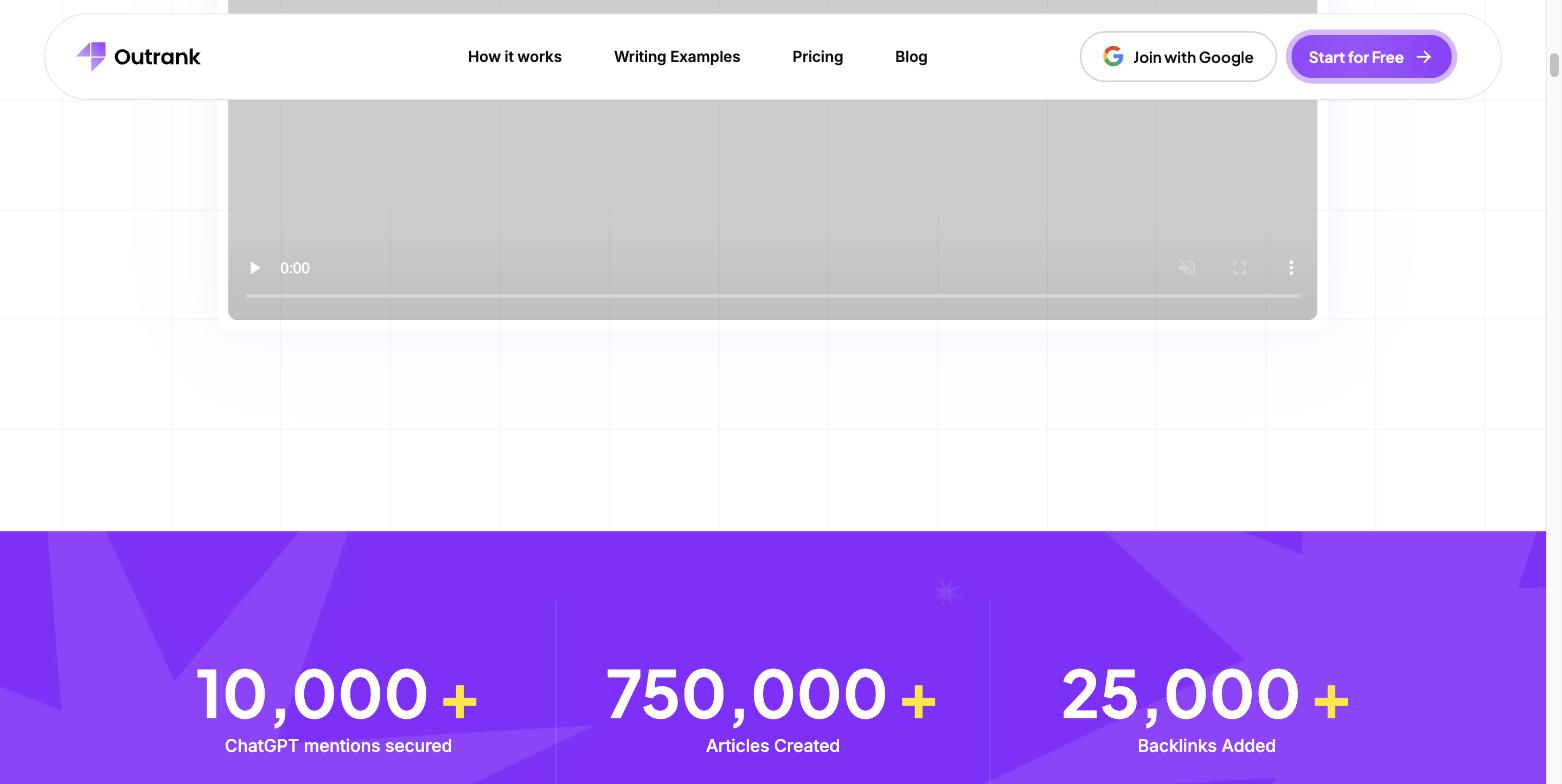
It is explicitly part of the pitch — "Get recommended by ChatGPT & Rank on Google" — and Outrank reports over 10,000 ChatGPT mentions secured across its customers. The underlying logic is sound: AI answers are assembled from indexed content, so publishing structured, well-linked pages on a topic raises the odds of being drawn on. The caveat is that this is a claim about a correlation nobody can currently audit, and the figure is self-reported with no published methodology for what counts as a mention.
How is Outrank different from Altheo?
Of the tools we have reviewed, Outrank overlaps with us the most, so treat this as a competitor talking. The difference is volume versus deliberation. Outrank is built to publish 30 articles a month on autopilot and acquire links through its exchange; the goal is consistent output without your involvement. Altheo plans a topical cluster first and asks which articles are worth writing, builds off-page authority through directories, reviews and mentions rather than reciprocal links, and also covers technical health, website conversion and social — none of which Outrank does. If your problem is that nothing gets published, Outrank solves it more directly than we do. If your problem is that what you publish is not converting, or that your site’s foundations are weak, that is our half.
How was this review put together?
From Outrank’s own public pages read in July 2026, its founder’s public posts, and published reviews including hands-on testing from EntreResource, theStacc, MassBlogger and Aboah Reviews. All screenshots are our own captures. We did not run a paid account for a full billing cycle, so this assesses the product’s claims, mechanics and documented user experience rather than reporting our own ranking results. Where reviewers disagree — content quality ratings in particular — we have given the range rather than the most flattering number.