Okara review: the $99 AI CMO, taken seriously
Okara sells ten-plus marketing agents — SEO, GEO, Reddit, Hacker News, X, LinkedIn, long-form writing, technical fixes — for less than a freelancer charges for four articles. The product underneath is better than the sceptics say. The marketing on top of it is worse than the product deserves.
Our rating: 3.8 out of 5. Reviewed July 2026.
Disclosure: this review is published by Altheo, an AI marketing platform aimed at broadly the same customer as Okara. Read it with that in mind. Every criticism here is tied to a claim on Okara’s own site or to a named third-party source, we say plainly where Okara is ahead of us, and there are no affiliate links on this page — we earn nothing whether you buy Okara or not.
The verdict
Okara is a good tool wrapped in claims it cannot support. Strip away the "$14,000/month department for $99" framing and what remains is a well-assembled bundle: a Search Console-driven SEO agent, an AI-answer visibility tracker that is genuinely ahead of the market, a Reddit thread-finder that respects the platform enough to make you post manually, and a competent drafting layer across every channel a small company cares about. That is a reasonable $99 a month.
What it is not is a CMO. It automates the bottom of the marketing job — finding, drafting, flagging — and leaves every decision that makes marketing hard exactly where it was: with you. Buy it as leverage for the person already doing your marketing. Do not buy it instead of that person.
What Okara actually is
Okara Technologies was founded in 2025 in Singapore by Fatima Rizwan, who previously built TechJuice into Pakistan’s largest technology publication and was named to the Forbes 30 Under 30 Asia list in 2016. The company’s first product was an encrypted, privacy-first AI chat workspace running twenty-plus open-source models, which launched on Product Hunt in late 2025 and grew to a reported 30,000 users within five months. The AI CMO arrived in March 2026.
Mechanically: you give it your URL, it reads your public site, builds a product profile, generates a strategy document, audits your SEO, and begins filling an Agents Feed with opportunities and drafts. Connect Google Search Console and GA4 and the recommendations become grounded in your real impressions and traffic rather than generic advice. From then on it is a daily queue — threads to reply to, posts to publish, articles to write, fixes to ship, citations you are missing in AI answers.
That framing is the most useful way to understand what you are buying. Not a strategist. A very well-read intern who never sleeps, hands you twenty things before breakfast, and has no idea which three matter.
What $99 a month actually buys — and why that is the wrong question
The list price is $99/month for 2,000 credits, the full agent suite, and Google Search Console and GA4 integration. The pricing page shows $82.50/month, which is the annual plan ($990/year, marketed as two months free) expressed monthly. The free tier needs no credit card and currently carries 20 credits, though testers earlier in 2026 documented 5.
The $99 does not buy the product. It buys 2,000 credits of the product, and that distinction is the most expensive thing on the page to misread. Okara publishes no definition of a credit, no per-action cost, and no policy for what happens when the meter empties. A site analysis, a long-form article, a daily Reddit sweep and an AI-video generation are obviously not equivalent draws on that budget, but you cannot find out by how much until you have already spent them.
This matters because the pricing is presented as flat. Okara writes on its own blog that it is "flat ~$99/month" and that "you know the number regardless of how much it produces" — an explicit contrast with usage-based competitors. A metered product cannot be flat in both directions. Either you hit a wall partway through the month and the flat price bought you materially less than the feature list implied, or there is a paid path past the wall that the pricing page does not disclose. Both readings leave a buyer unable to forecast an annual cost, and the reasonable assumption — that everything listed is included in an already-substantial $99 — is the one the page does least to support.
The free tier proves the wall is real rather than theoretical. One first-hand tester at Tribe Chat hit a usage limit before the initial website analysis had even finished, and concluded that zero value was delivered. Treat $99 as a floor rather than a price, budget above it, and ask for a credit-cost table before committing to an annual plan.
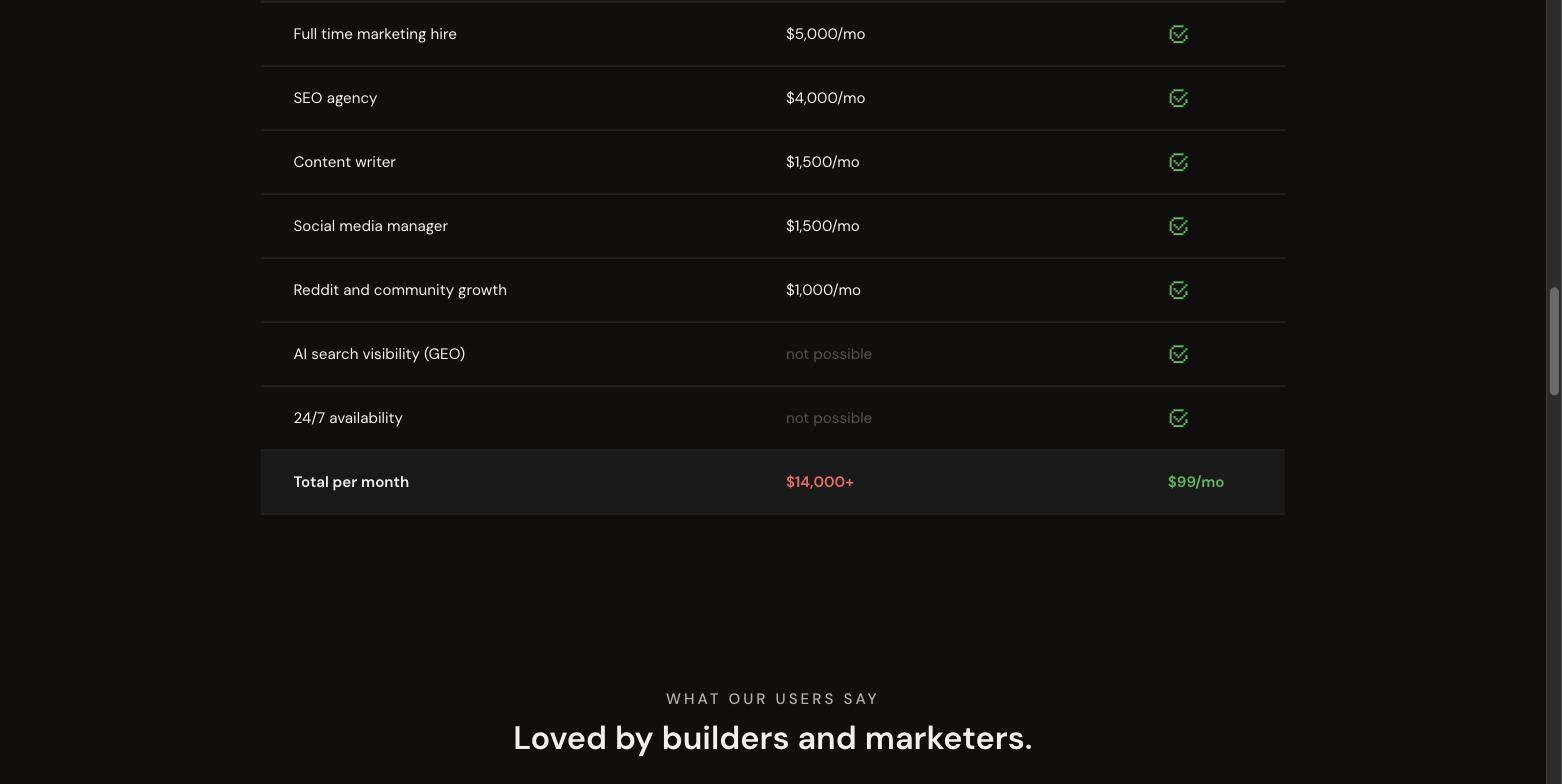
The $14,000/month comparison on the pricing page stacks a $5,000 full-time hire, a $4,000 SEO agency, a $1,500 content writer, a $1,500 social media manager and $1,000 of community growth. No company that would consider a $99 tool employs all five at once. The honest baseline for Okara’s real buyer is a freelance writer and an SEO tool — roughly $200 to $600 a month. Okara plausibly still wins that comparison; it is simply impossible to confirm without knowing what a month of real usage actually costs.
Which claims hold up
The weakest claim is the social proof. "Used by 100,000+ users and trusted by teams at" sits above a wall of enterprise logos including Kong, VWO, Razer and Photoroom. That figure appears to span the whole company, including the separate chat product; presented on an AI CMO page it reads as adoption of a product those companies are very unlikely to be buying. The wording is carefully chosen and technically defensible; the impression it creates is not.
Several testimonials also come from people who published reviews of the product, including writers at Incrypted and Digit.in, which quietly turns press coverage into endorsement.
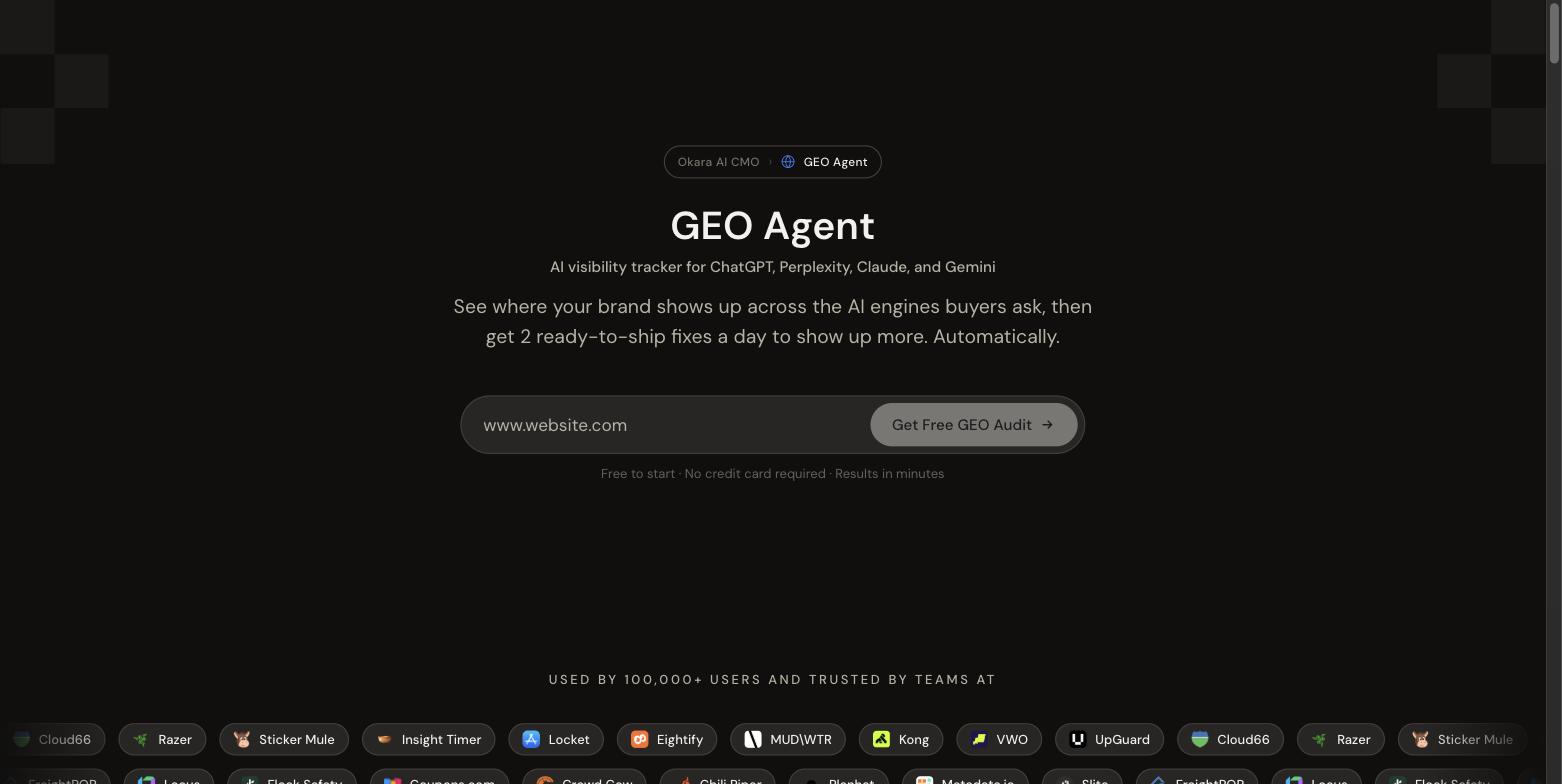
"You post from your own account — always ban-safe" is overstated. The human-in-the-loop design is real and better than auto-posting, but bans follow content and account behaviour, not the mechanism of posting. "The world’s first AI CMO" is positioning rather than fact. The GEO agent’s daily tracking across ChatGPT, Perplexity, Claude and Gemini is entirely plausible and useful, but no public methodology explains how prompts are sampled or how a citation is counted, so the numbers cannot be independently checked.
What Okara gets right
The bundle is genuinely coherent. SEO, GEO, community distribution, social, long-form and technical fixes usually live in five subscriptions and three browser tabs; Okara puts them behind one login with a shared product profile, so the SEO agent and the LinkedIn agent are at least arguing from the same understanding of what you sell.
Human-in-the-loop is a design decision, not a disclaimer. Agents draft, you approve, you post from your own account. In a category racing toward full autonomy, choosing the slower and safer default costs them demo appeal and deserves credit.
The GEO agent is ahead of the market. Tracking brand citations inside AI answers, with competitor share of voice, is the thing most marketing teams now know they should measure and have no tooling for. The free tier is honest, the paid tier is a single legible price, and the Google Search Console and GA4 integrations mean recommendations are grounded in real data rather than generic best practice.
Where it falls short
Output is a starting point, not a deliverable. This is the most consistent finding across every review we read, favourable ones included: the drafts are competent and generic. If your plan is to publish them unedited, you are buying a way to add mediocre content to the internet at speed, which in 2026 is a ranking liability rather than a ranking strategy.
Reddit and Hacker News are where this goes wrong in public. Communities have become extremely good at spotting generated replies, and the punishment is a visible thread about your brand rather than a quiet removal. Every reply needs genuine rewriting, which erases most of the time saving that justified the subscription.
It automates execution, not judgment. Deciding which market to attack, what to call the product, which channel to abandon, what to charge — none of that is in the box. At least one agent, Link Broker, is still marked coming soon while appearing in the ten-plus count.
And the credit meter undercuts the value case that justifies the subscription. The agents most worth paying for — the daily Reddit sweep, the GEO scan, long-form drafting — are presumably the ones that consume the most, so the harder you lean on Okara the sooner you meet a limit whose cost you were never shown.
How Okara and Altheo compare
Altheo publishes this review and competes with Okara, so this is a statement of philosophy rather than a neutral comparison. The clearest way to split the two is by where each is strongest.
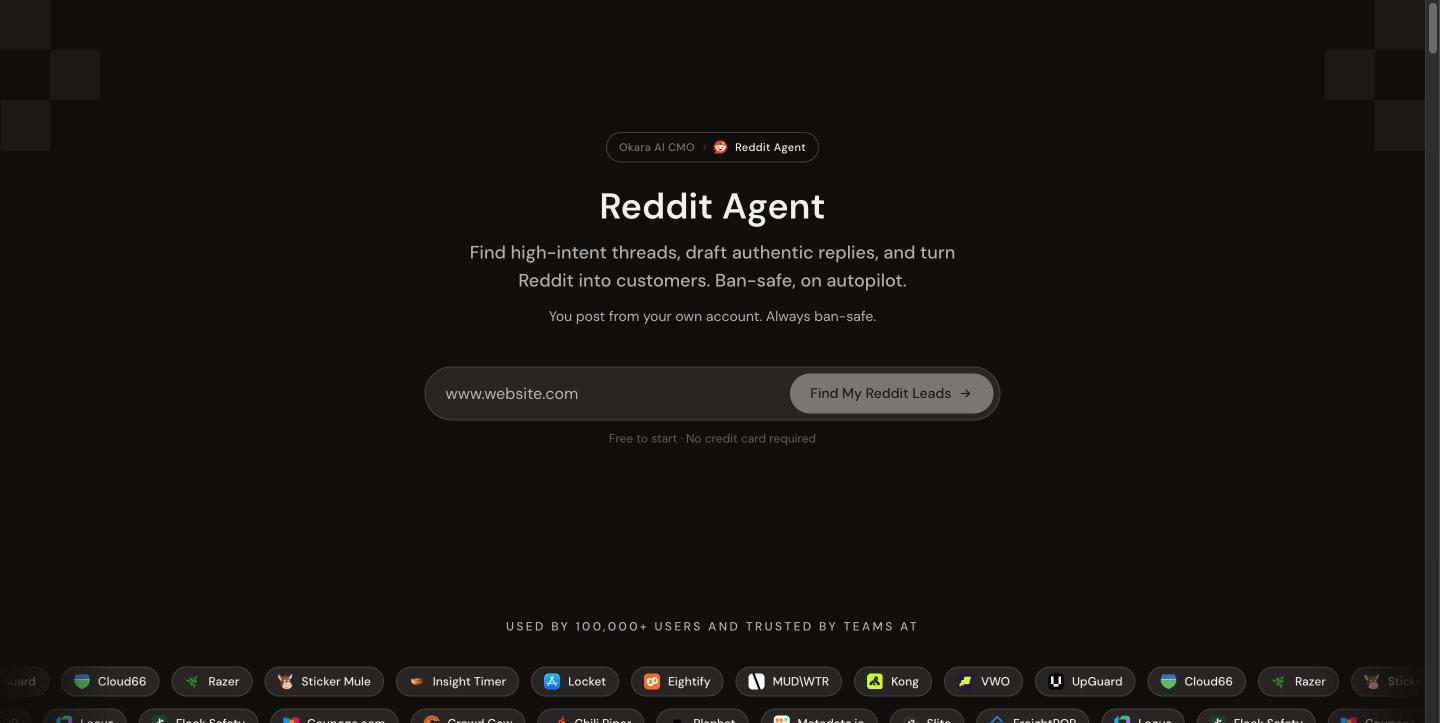
Okara is stronger on off-page SEO and distribution. The Reddit agent scanning subreddits for high-intent threads is the best example of it, and the Hacker News, X and LinkedIn agents push the same daily volume. If the bottleneck is getting mentioned in places you do not own, that is what Okara is built for, and it has more shipped agents and native Google Search Console and GA4 integration today.
Altheo is stronger on the two things that decide what happens once someone actually arrives: technical foundations and website conversion. We audit and fix the site itself, and the conversion review is read by a person rather than generated, because building a stronger website is a different job from generating more posts about it. Traffic sent to a page that does not convert is the most expensive kind of marketing there is.
Who should buy it, and who should skip it
Buy Okara if you are a solo founder or a team of two or three with something real to promote and no marketing hire, you already have a live site with Search Console history, your bottleneck is starting rather than editing, and you can commit an hour a day to reviewing what the agents queue up.
Skip it if you already employ a marketer or an agency, if you operate somewhere thin content is actively harmful such as fintech, security, health or legal, if you want autonomy rather than a co-pilot, if you need it to plug into your own automations, or if you are pre-product. Distribution tooling cannot fix having nothing to distribute.
Frequently asked questions
Is Okara actually worth $99 a month?
For a solo founder with a live product and no marketer, plausibly yes — but not for the reason the website gives. You are not replacing a $14,000/month department. You are replacing a freelance writer and an SEO tool subscription, which is a $200–$600/month problem, and getting AI-answer visibility tracking thrown in. Judged against that realistic baseline it is priced fairly. Judged against the marketing, it will disappoint. Start on the free tier, accept that it is too thin for a real evaluation, and decide after one paid month whether you are actually shipping what it drafts.
Will the Reddit agent get my account banned?
Not by itself. Okara does not post for you — it drafts replies and you publish them from your own account, which is the safer of the two possible designs and better than several competitors. But bans follow content, not mechanism. If you paste lightly edited generated replies into multiple subreddits, moderators and users will spot it, and the cost is a public thread about your brand rather than a quiet removal. Use the agent to find threads, which it does well, and write the actual reply yourself.
Does Okara really have 100,000 users?
Okara the company plausibly does. Okara the AI CMO almost certainly does not. The company shipped an encrypted multi-model chat product first, in late 2025, and third-party coverage put that at around 30,000 users within five months. The AI CMO launched in March 2026. The 100,000 figure sits on the AI CMO homepage above enterprise logos, which invites you to read it as AI CMO adoption. That framing is the least trustworthy thing on an otherwise reasonable site.
What does Okara cost, exactly?
Nobody can tell you, and that is the problem. The list price is $99/month. The pricing page shows $82.50/month, which is the annual plan ($990/year, billed yearly, marketed as two months free) expressed monthly. There is a free tier with no credit card — currently 20 credits, though testers earlier in 2026 documented 5. A $20/month Pro tier has appeared and disappeared, and a $1,000 lifetime "Founding User" offer circulated around launch. But the $99 does not buy the product, it buys 2,000 credits of the product, and Okara publishes no definition of a credit and no per-action costs anywhere on the pricing page. Your real annual cost depends entirely on a conversion rate the vendor has not disclosed.
What happens when you run out of Okara credits?
Okara does not say, and that silence is the single biggest reason to discount the headline price. The $99 plan is metered at 2,000 credits a month. The pricing page defines no credit, itemises no action, and states no policy for exhaustion — it does not tell you whether agents pause until the reset, whether you are prompted to buy more, or what more would cost. Okara markets the plan as flat, writing on its own blog that it is "flat ~$99/month" and that "you know the number regardless of how much it produces." A metered product cannot be flat in both directions: either you hit a wall and the flat price bought you less than you expected, or there is a paid path past the wall that is not disclosed. The free tier shows the wall is real — one tester at Tribe Chat hit a usage limit before the initial website analysis had even finished. Treat $99 as a floor, budget for more, and ask Okara for a credit-cost table before committing annually.
Can Okara replace a marketing hire?
It can replace a fraction of a junior one. It is good at the mechanical layer: finding keyword gaps, spotting relevant threads, producing first drafts, flagging technical fixes, tracking where you are cited. It cannot decide positioning, judge whether a channel is worth continuing, negotiate a partnership, or notice that your entire message is aimed at the wrong buyer. Those are the decisions that make marketing hires expensive, and none of them are automated here. Buy it as leverage for whoever is already doing the job, not as a substitute for having someone do it.
How is Okara different from Altheo?
Both are AI marketing systems for teams without a marketing department, so the overlap is real and we are not a neutral party here. The clearest way to split them is by where each is strongest. Okara is stronger on off-page SEO and distribution: the Reddit agent scanning subreddits for high-intent threads is the best example, and its Hacker News, X and LinkedIn agents push the same daily volume. If getting your product mentioned in places you do not own is the bottleneck, Okara is built for that. Altheo is stronger on the two things that decide what happens once someone arrives: technical foundations and website conversion. We audit and fix the site itself, and our conversion review is read by a person, because building a stronger website is a different job from generating more posts about it. The structural difference follows from that: Okara is one feed of daily suggestions organised by channel, Altheo is five pillars organised by the outcome each drives. Okara also has more shipped agents and native Google Search Console and GA4 integration today.
Is the GEO agent worth taking seriously?
It is the most forward-looking part of the product. Tracking whether your brand appears in ChatGPT, Perplexity, Claude and Gemini answers — with competitor share of voice — addresses a measurement gap most teams now feel and few tools have filled. The honest caveat is that no vendor in this space, Okara included, publishes how they sample prompts or count a citation, so the trend line is more trustworthy than the absolute number. Watch direction, not decimals.
How was this review put together?
From Okara’s own public pages (homepage, pricing, and individual agent pages), third-party coverage of the company and its March 2026 launch, and published reviews including first-hand testing from Tribe Chat and assessments from MakerStack, Incrypted and Efficienist. We did not run a paid account through a full campaign cycle, so this is an assessment of the product’s claims, design and documented user experience rather than a longitudinal performance test. Where sources conflict — and on pricing they frequently do — we have said so instead of choosing the convenient number.