Conversion review: powerful marketing automation, built for people who already speak Salesforce
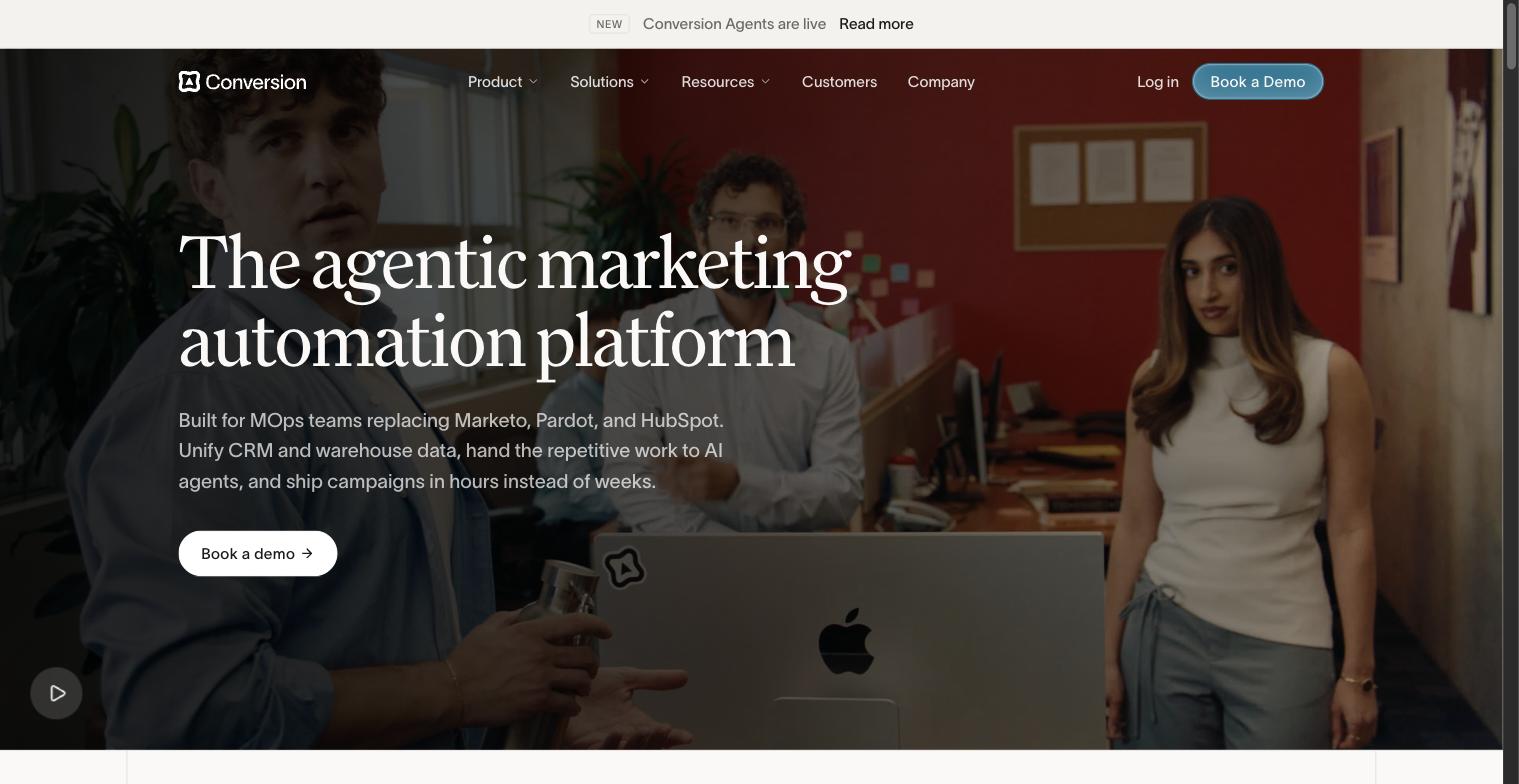
Conversion is a marketing automation platform built to replace Marketo, Pardot and HubSpot for MOps teams, and it has built something genuinely uncommon: one data model unifying CRM, warehouse and product-event data with a native bidirectional Salesforce sync. The question this review turns on is who can actually reach the product at all.
Our rating: 3.9 out of 5. Reviewed August 2026.
Disclosure: published by Altheo. We do not compete with Conversion in any real sense — different category, different buyer. No affiliate links on this page.
The verdict
What Conversion has actually built is real. One data model unifies Salesforce, a data warehouse and product events with custom objects and a native bidirectional CRM sync — no reverse-ETL, no middleware — and its security posture (SOC 2 Type II, SSO, SCIM, RBAC, audit logs) is more complete than most companies this size bother with. Every G2 review we read gave it 5 out of 5, and the customer list — OpenAI, Clay, HockeyStack, 11x — is credible rather than padded.
The reservation is about who can reach it. There is no pricing page, no free trial and no self-serve signup — one of Conversion's own G2 reviewers said they "would have loved to be able to do a free trial or online demo of Conversion before purchasing." And while the FAQ insists warehouse setup takes "no SQL, no dbt models, no engineering tickets," the rest of the product runs on custom objects, Liquid templating and a query builder — the language of someone who already thinks in CRM data models. Good software, aimed narrowly, and not this site's typical reader.
What Conversion actually is
A San Francisco company built on the thesis that Marketo and Pardot were designed for a world before data warehouses, product-led growth and AI agents existed, leaving MOps teams to stitch together a CDP and a reverse-ETL tool alongside their MAP just to see a complete customer picture.
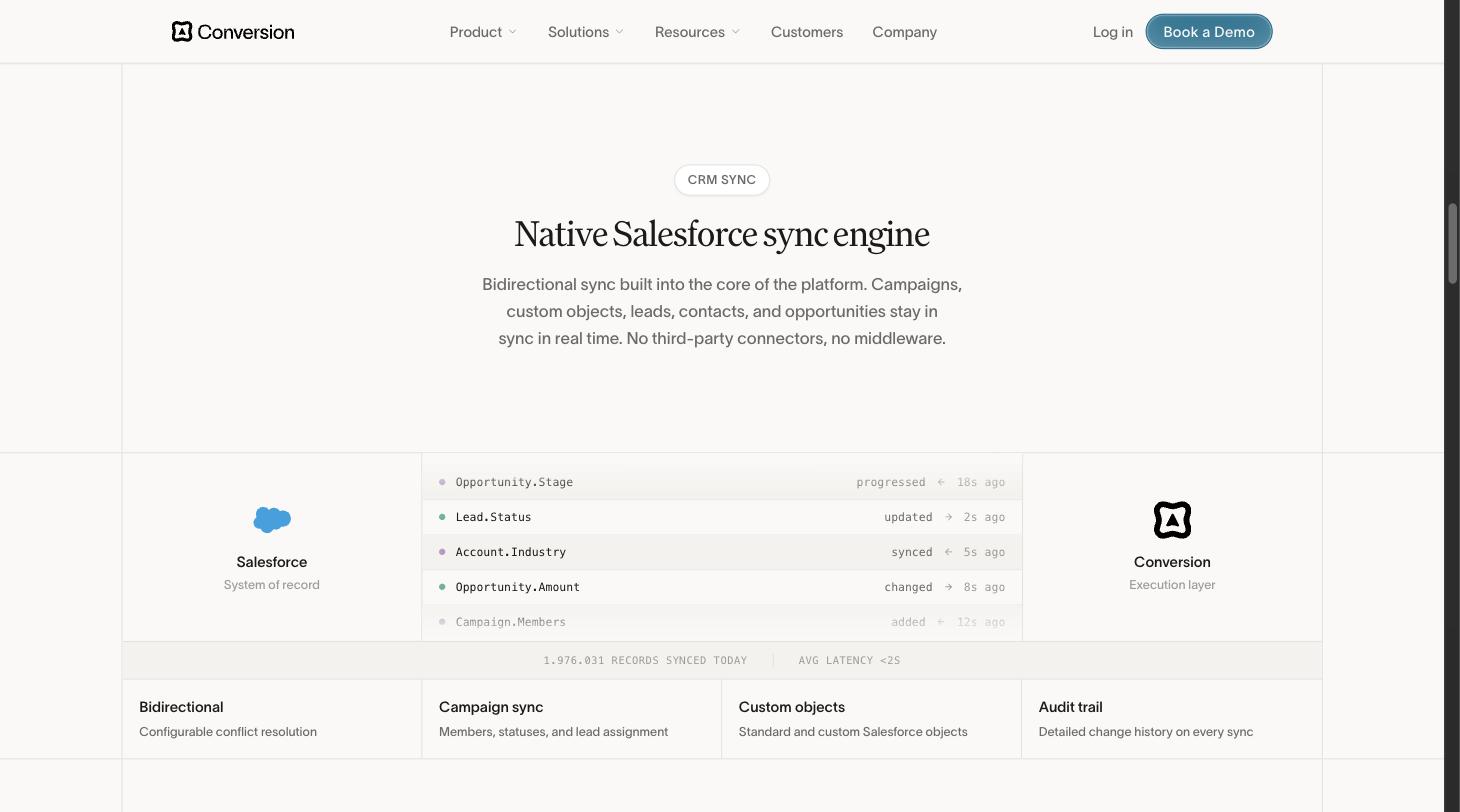
Its answer is a single data model — custom objects, one-to-one, one-to-many and many-to-many relationships, event streams — underneath segmentation, personalization, workflows and reporting, syncing bidirectionally with Salesforce in real time rather than through a batch connector.
The company reports customers seeing a 75% reduction in marketing ops hours and 10x faster campaign launches, and names OpenAI, Clay, HockeyStack, 11x, Warmly, Motion, Origami, Vectara, Paraform and Abacum as customers — self-reported figures and a curated logo list, but specific and checkable names rather than vague claims.
"No engineering needed" is true for one step, not the whole product
Conversion's own FAQ states: "Marketing ops teams can configure warehouse connections through the UI with read-only credentials... No SQL, no dbt models, no engineering tickets." That claim is specifically about warehouse connection setup, and is plausible for that one step. It is not a description of daily use.
Once connected, a marketer is expected to build segments from a query engine, write personalization in Liquid templating syntax, and navigate a data model organised around custom objects with one-to-one, one-to-many and many-to-many relationships — real capabilities, and ones a first-time or non-technical marketer will find genuinely unfamiliar, whatever the FAQ's framing implies.
The buying process reinforces the same audience. conversion.ai/pricing returns a 404. There is no free trial and no self-serve signup anywhere on the site; every call to action is "Book a Demo" or "Log in." One of Conversion's own G2 reviewers, rating the product 4.5 out of 5, made the same point from the buyer's side: "I would have loved to be able to do a free trial or online demo of Conversion before purchasing. This would have allowed me to come to a decision quicker."
None of this is a defect — a product built for a MOps team already running Salesforce and a warehouse, sold through an enterprise sales process, is a coherent shape for B2B software. It means the intersection of "can use this well" and "can get in the door to find out" excludes almost anyone without an existing CRM and a data team, which includes most solopreneurs and most non-technical marketers.
We also checked whether Conversion's own marketing site is legible to AI crawlers, the same test we run on every product reviewed here: fetched with GPTBot's user agent and no JavaScript execution, the homepage's full headline, subhead and navigation copy were present in the raw HTML. Unlike some products in this category, the marketing site itself is not hiding its content from AI crawlers.
Conversion Agents, and how little external signal exists on it yet
Conversion Agents — AI agents handling tickets, QA, reporting and campaign builds "on a schedule, on a trigger, or whenever you ask" — is the platform's newest module and still carries a site-wide "NEW" badge. Conversion's own official demo video for it, "Conversion Agents | Official Demo," had 183 views on a 608-subscriber YouTube channel when we checked, which is close to no independent signal on how the feature performs outside a scripted walkthrough. We have not run it ourselves and are not scoring it on its merits, only on how little independent evidence currently exists.
No price, no trial, one door in
conversion.ai/pricing returns a 404. There is no tier comparison, no starting price and no self-serve checkout anywhere on the site — "Book a Demo" is the only path forward. Third-party software trackers report an entry price around $900 a month billed on active contacts, but we could not confirm that figure anywhere on Conversion's own site, and G2's own listing states pricing "isn't currently available." Treat it as a rough external estimate, not a quote.
That is a deliberate choice for an enterprise sales motion and it filters for exactly the buyer Conversion wants — but it also filters out anyone evaluating tools solo, on a budget, or on a timeline shorter than a sales cycle.
What independent reviewers report, and who it is for
Every G2 review we could read scored Conversion 5 out of 5 across 22 reviews, with specific detail: a one-click Salesforce integration reviewers called "light years ahead of other solutions," a dedicated Slack channel with deployment specialists responding "usually within minutes," and broad team adoption inside the first month. We found no Capterra or Trustpilot listing for Conversion at all.
Buy Conversion if you already run Salesforce and a data warehouse, a MOps or RevOps function owns the stack, and you are big enough to run a sales-assisted enterprise buying process replacing Marketo, Pardot or HubSpot. Look elsewhere if you are a solopreneur or small team without a CRM to connect to, want to try before you buy, or need to see a price before you will get on a call.
Altheo barely competes with Conversion. Conversion is an enterprise marketing automation platform sold to MOps teams; Altheo is five SEO and conversion tools built for people, often solo and often non-technical, trying to get an existing site found and read — several free with no account. The only overlap is a sliver: Conversion's "Forms & Pages" builder brushes against Altheo's website conversion pillar, and that is the entire overlap.
Frequently asked questions
How much does Conversion cost?
Conversion does not publish pricing. There is no pricing page on the site — conversion.ai/pricing returns a 404 — and the only path to buying is booking a demo with sales. Third-party trackers report an entry price around $900 a month billed on active contacts, but we could not confirm that figure against Conversion's own materials, so treat it as an estimate rather than a quote. Budget for an enterprise sales cycle, not a self-serve checkout.
Is there a free trial or self-serve signup?
No. Conversion has no free trial, no self-serve signup and no public pricing — every path on the site leads to "Book a Demo" or "Log in." This is not a hidden limitation: one of Conversion's own G2 reviewers, rating the product 4.5/5, wrote that they "would have loved to be able to do a free trial or online demo of Conversion before purchasing," and that it "would have allowed me to come to a decision quicker." If you want to try before you buy, this product will not let you.
Do I need engineering help to set up Conversion?
Conversion's own FAQ says no: "Marketing ops teams can configure warehouse connections through the UI with read-only credentials... No SQL, no dbt models, no engineering tickets." That claim is about warehouse connection setup specifically, and it is plausibly true. It does not describe the rest of the product surface. Segmentation is built from a query engine, personalization runs on Liquid templating syntax, the data model is organised around custom objects with one-to-one, one-to-many and many-to-many relationships, and access is controlled through role-based permissions. None of that requires an engineer sitting next to you, but all of it requires the vocabulary of someone who already thinks in CRM objects and data models — which is a different bar than "no engineering needed" implies.
Who is Conversion actually built for?
Marketing operations and revenue operations teams at companies that already run Salesforce and a data warehouse, and are big enough to replace Marketo, Pardot or HubSpot with an enterprise contract. Conversion's own security page is aimed at IT and security teams (SOC 2 Type II, SSO/SAML, SCIM provisioning, audit logs), its data model page is aimed at people who already know what a reverse-ETL tool is, and its buying funnel — demo-only, no published price — is built for a sales-assisted enterprise deal, not an individual signing up with a credit card. If you are a solopreneur, a small team without a CRM, or a non-technical marketer, this product is not describing you anywhere on its site.
Is Conversion good, based on independent reviews?
By the numbers we could find, yes, though the sample is thin. Conversion holds a 5.0 out of 5 rating on G2 from 22 reviews and carries G2's "High Performer" badge, and every review we read was uniformly positive — praise clustered around the speed of the Salesforce sync, the depth of the data model, and unusually hands-on onboarding support. We could not find a Capterra or Trustpilot listing for the product at all. Twenty-two reviews, all five stars, from a company still building out its review presence is a genuinely good sign, but it is a small enough sample that we would not treat it as the last word.
What is "Conversion Agents"?
Conversion's newest feature, launched recently enough that it still carries a "NEW" badge across the site: AI agents that handle tickets, QA, reporting and campaign builds on a schedule, on a trigger, or on request, with what Conversion describes as the same context and approval model as a human operator. The company's own demo video for it — "Conversion Agents | Official Demo" on its YouTube channel — had 183 views on a 608-subscriber channel when we checked. That is not a criticism of the feature itself, which we have not run ourselves, but it does mean there is close to no independent signal yet on how it performs outside Conversion's own demo.
How does Conversion compare to Marketo, Pardot and HubSpot?
Conversion positions itself directly against all three, and its pitch is architectural rather than feature-for-feature: legacy MAPs, in Conversion's framing, force a rigid contact-only data model with no custom objects and no warehouse data, so MOps teams end up stitching together a CDP and a reverse-ETL tool just to get a full customer picture. Conversion's data model — custom objects, native bidirectional Salesforce sync, direct warehouse connections — is built to collapse that stack into one platform. We have not run a side-by-side migration to verify the claim ourselves, but it is a coherent and specific argument, not vague positioning.
How does Conversion compare to Altheo?
They are barely in the same category. Conversion is an enterprise marketing automation platform — email, CRM sync, workflows, reporting — built to replace Marketo, Pardot or HubSpot for a MOps team. Altheo is five SEO, content and conversion tools organised by outcome, several free with no account, built for people (often solo, often non-technical) trying to get an existing website found and read by search engines and AI assistants. The only point of contact is a sliver of Conversion's product — its "Forms & Pages" builder — brushing against what Altheo's conversion pillar covers, and Altheo does nothing resembling CRM sync, warehouse connections or lifecycle marketing. We compete for approximately no one's budget in common, so read this comparison as informational rather than competitive.